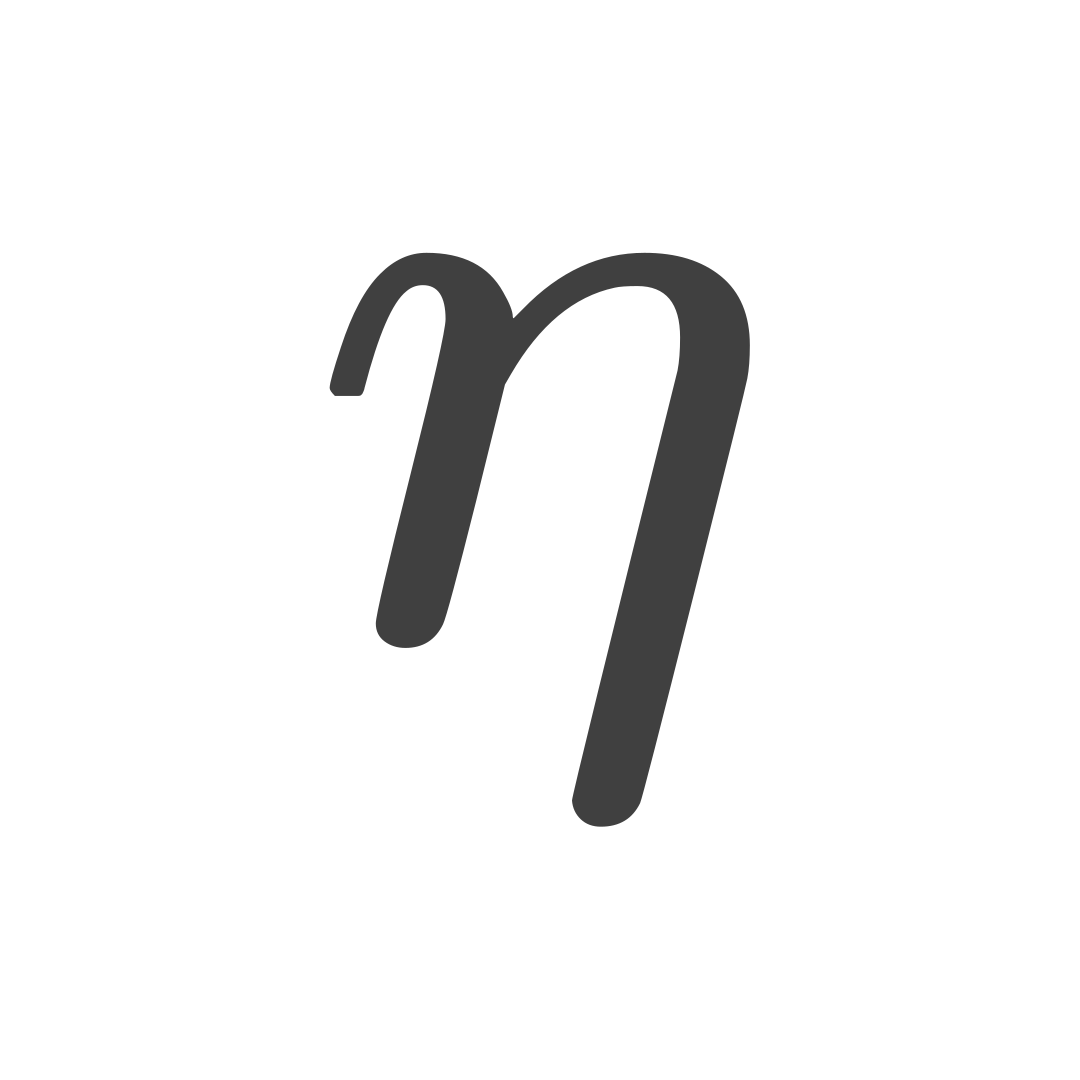
Isotopes of the Same Element Have Different Masses
Hydrogen in the Sun, carbon in our bodies, and oxygen in water do not always appear as only one mass version. One element can have several atoms with the same number of protons but different numbers of neutrons. Those atoms are called isotopes.
Isotopes are atoms of the same element with the same atomic number but different mass numbers.
Read the pattern like this:
Isotopes have the same , but different neutron counts and different mass numbers .
The symbol is the atomic number, which equals the number of protons. The symbol is the mass number, which equals protons plus neutrons. If is the same, the element is the same. If is different, the mass number also changes.
Isotopes belong to the same element because they have the same number of protons. Different numbers of neutrons give them different mass numbers.
Isotope Model
Choose an isotope below. First notice what does not change: the number of protons. Then compare the neutron count.
- Atomic number
- Mass number
- Neutrons
- Representative isotopic composition
- About
- Protons
- Neutral electrons
- Neutrons
- Has no neutrons.
Three Isotopes of Hydrogen
All hydrogen isotopes have proton. Because their proton count is , they are still hydrogen. The difference is their neutron count.
| Hydrogen isotope | Symbol | Protons | Neutral electrons | Neutrons |
|---|---|---|---|---|
| Hydrogen-1, or protium | ||||
| Deuterium | ||||
| Tritium |
Deuterium is sometimes written as , and tritium is sometimes written as . Those shortcuts do not mean new elements. Deuterium and tritium are still hydrogen because their proton count is still .
Carbon Isotopes Differ in Neutron Count
Carbon always has protons. In , , and , the neutron count increases.
and are stable. is radioactive, so its amount in nature is extremely small. Because decays over time, scientists can use it to estimate the age of objects that once came from living things, such as old wood or bone.
Differences between Isotopes and Ions
An ion forms when an atom gains or loses electrons. Isotopes of the same element differ in their number of neutrons.
| Concept | Particle count that differs | Particle that determines the element |
|---|---|---|
| Ion | Electrons | Protons |
| Isotope | Neutrons | Protons |
For example, is a carbon ion because its electrons changed. In contrast, is a carbon isotope because its neutron count is different from .
If the atom is neutral, electrons still equal protons:
So neutral has protons, electrons, and neutrons.
Uses of Isotopes
Neutron count affects an isotope's mass and nuclear stability. Those properties determine why a particular isotope can serve as a tracer, a possible energy source, or a clock for estimating the age of a material.
Deuterium and tritium are studied as a fuel pair in fusion energy research.
is used in radiocarbon dating to estimate the age of organic materials, meaning materials that once came from living things. This method can determine ages up to about years.
Any use of an isotope must account for its nuclear stability, meaning whether its nucleus tends to decay. Radioactive isotopes such as tritium and require controlled procedures and radiation-safety rules.
From Isotopes to Average Atomic Mass
On the periodic table, relative atomic mass is often a decimal. That number is not the mass number of one isotope. Relative atomic mass is calculated from the mass of each isotope and its abundance in a reference sample.
The tabulated percentages are a representative isotopic composition for reference materials. The composition can vary with a material's origin and treatment. The percentages below are therefore reference values, and a particular natural sample may differ.
Carbon is an easy example:
| Carbon isotope | Mass number | Representative isotopic composition |
|---|---|---|
| About | ||
| About | ||
| Not included in the NIST stable-isotope composition |
Because is the most abundant carbon isotope, carbon's relative atomic mass on the periodic table is close to , but not exactly .
Distinguishing Isotopes by Atomic and Mass Numbers
Use these three questions whenever you read an isotope:
- How many protons are there?
- What is the mass number?
- How many neutrons come from ?
For :
So has neutrons. The relation works for any isotope with a known atomic number and mass number, so no neutron table is needed.