Atomic Number Sets the Order
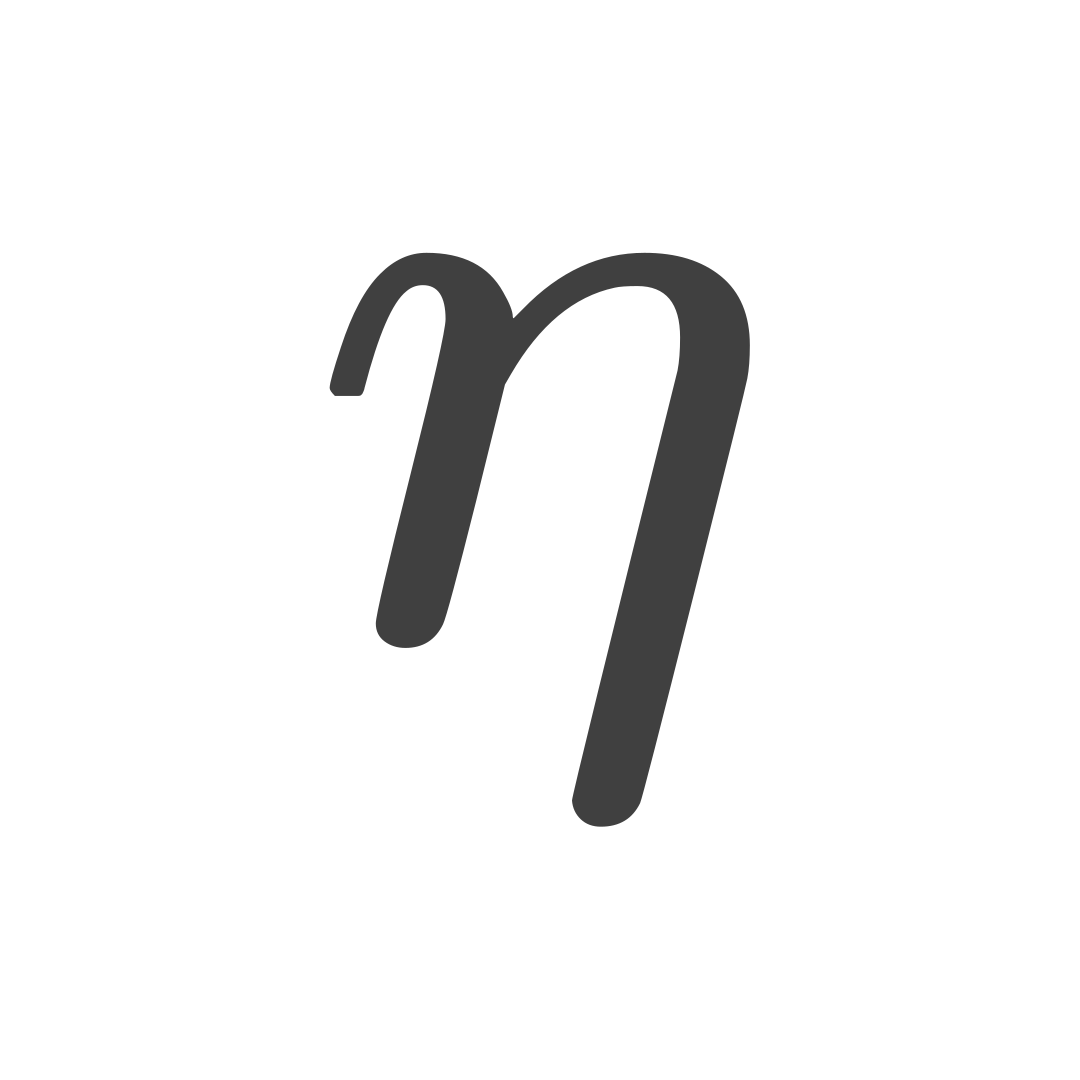
Each box in the modern periodic table represents one element. The elements are arranged by increasing atomic number, written as . The atomic number is the number of protons in an atom's nucleus.
Increasing atomic number produces repeating patterns in chemical properties.
In the main groups, elements in one column often have the same number of valence electrons. Hydrogen is in group because it has electron, but it does not behave exactly like the alkali metals.
- Focus
- A column with a similar outer pattern
- Group
- 1–18
- Period
- 1–7
- Atomic number
Periods and Groups
A period is a horizontal row. Periods are read from left to right and numbered to . In the simple shell model, elements in the same period have the same number of main occupied shells.
A group is a vertical column. Groups are read from top to bottom and numbered to . In the main groups, the number of valence electrons is often the same, so chemical properties tend to be similar.
Elements in one group are not identical. In the main groups, similar numbers and arrangements of valence electrons often produce similar reaction patterns.
Colors Mark Element Regions
The periodic table also divides elements into regions.
| Region | Typical location and behavior |
|---|---|
| Metals | Many are on the left and in the middle of the table. Many metals conduct electricity and tend to lose electrons when forming ions. |
| Nonmetals | Many are in the upper-right part of the table. Many nonmetals tend to gain or share electrons when bonding. |
| Metalloids | They sit at the boundary between metals and nonmetals. Their properties are in between, for example silicon can be used as a semiconductor. |
| Noble gases | They are in group . These elements are very unreactive because their outer electron arrangement is stable. |
Lists of elements classified as metalloids can differ among references because some elements have overlapping metallic and nonmetallic properties. Metalloids occupy the transition area between metals and nonmetals.
Why Two Rows Sit Below
If the lanthanides and actinides were drawn in the middle of the main table, the periodic table would become very wide. They are placed below to keep the table readable. They still occupy positions within the periodic system.
Lanthanides are still part of period , while actinides are still part of period .
Check Patterns in the Periodic Table
Use the periodic-table model in the interactive card to check your own answers.
| Question | Self-check |
|---|---|
| What group do , , and share? | All three are in group . |
| Why are through in period ? | In the simple shell model, their outer main shell is the shell. |
| Why are , , and classified as metalloids? | They have a mixture of metallic and nonmetallic properties and lie near the boundary between those regions of the table. |
| Why do main-group elements in one group often have similar chemical properties? | Main-group elements in the same group usually have the same number of valence electrons, so they often react in similar ways. |
The modern periodic table lists element names and atomic numbers. Arranging the elements by atomic number into periods and groups reveals recurring patterns.