Drawing an Ellipse with Two Fixed Foci
An ellipse can appear in a planetary orbit or in the shadow of a circle lit from an angle. Its geometric definition uses the distances to two fixed points.
An ellipse is the set of all points for which the sum of the distances to two fixed points is constant. Those fixed points are the foci. This definition can be modeled with two nails, a closed loop of string, and a pencil. Anchor the string at the nails, pull it taut with the pencil, and trace a full curve. The result is an ellipse.
In the visualization, lies on the ellipse. Its distance to , labeled , plus its distance to , labeled , has the same value for every point on the curve. This is the defining property of an ellipse.
Ellipse Components
Before using the formulas, identify the parts that determine an ellipse's position and shape.
The main components are:
-
Ellipse center is the midpoint of the ellipse, usually written with letter . All measurements in the ellipse refer to this point.
-
Foci ( and ) are two fixed points that define the ellipse. Their distance from each other is .
-
Major axis is the longest line that passes through the ellipse center and both foci. Its endpoints are points and .
-
Minor axis is the shortest line that passes through the ellipse center and is perpendicular to the major axis. Its endpoints are points and .
-
Semi-major () is half the length of the major axis, which is the distance from center to the major axis endpoint.
-
Semi-minor () is half the length of the minor axis, which is the distance from center to the minor axis endpoint.
A noncircular ellipse satisfies . In the limiting case , the two semiaxes are equal and the curve is a circle.
Ellipse Equations
The equation form depends on the center and on whether the major axis is horizontal or vertical. Read the center from the numbers subtracted inside each square, and read the direction from the squared term with the larger denominator.
Center at Origin
If the ellipse center is at , there are two possible orientations:
When the major axis is parallel to the axis (horizontal), the ellipse equation is:
This equation applies when .
When the major axis is parallel to the axis (vertical), the ellipse equation is:
This equation applies when .
Shifted Center
For an ellipse centered at , the equation becomes:
For a horizontal major axis:
For a vertical major axis:
Visualization:
Relationships Among Ellipse Lengths
The three characteristic lengths satisfy:
In this equation, is the distance from the center to either focus.
Eccentricity of an ellipse is defined as:
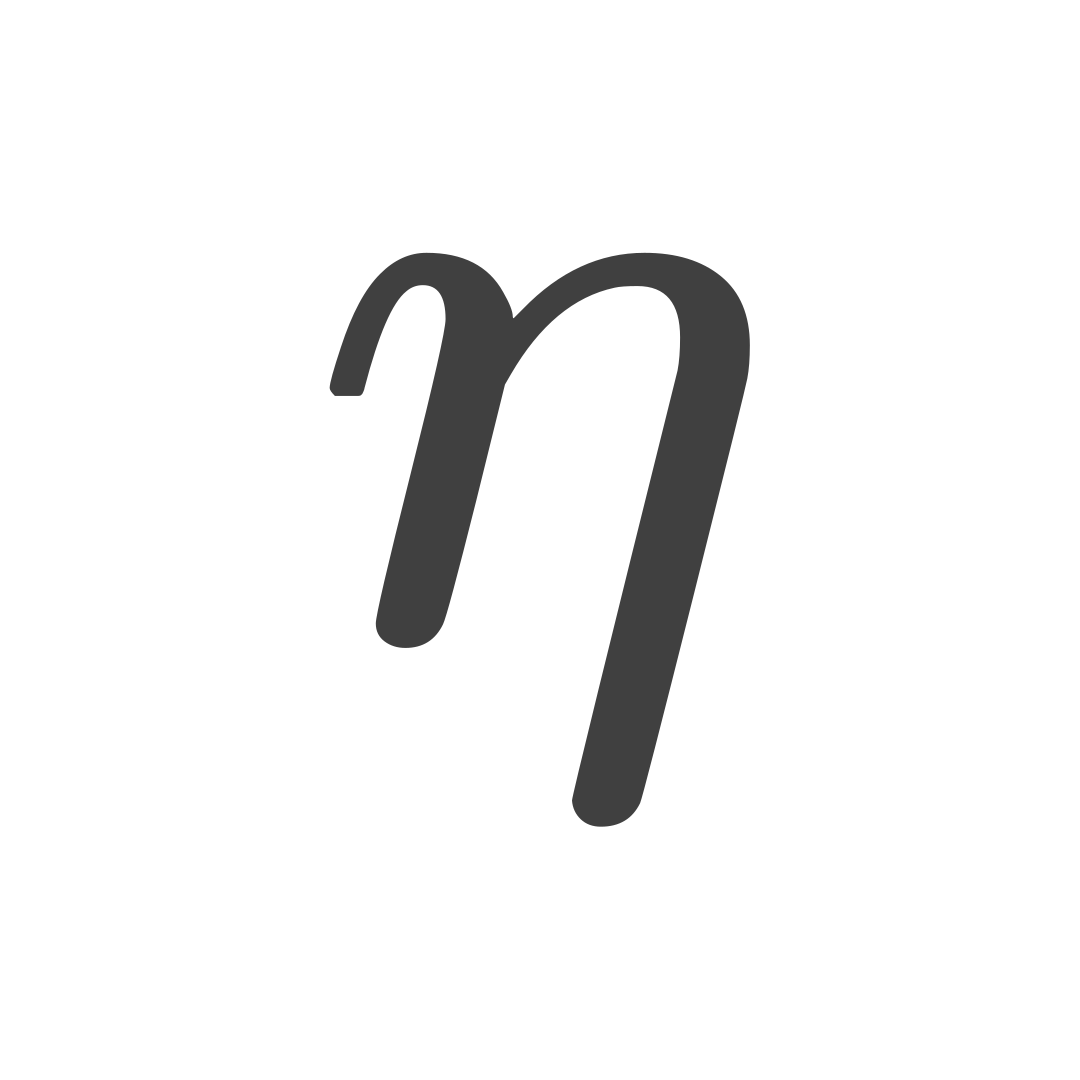
For a noncircular ellipse, . As approaches , the ellipse becomes more circular. As approaches , it becomes more elongated. The limiting circle has .
Exercises
Each problem gives an ellipse equation and asks for a feature such as its centre, its axes, or its foci, so rewrite the equation into its standard form before you read the values.
-
Find the equation of an ellipse with center at , major axis length and minor axis length , with horizontal major axis.
-
Given ellipse . Find the coordinates of the foci and the eccentricity of the ellipse.
-
An ellipse has center at , foci at and , and minor axis length . Find the equation of the ellipse.
-
Find the equation of an ellipse that passes through points and with center at and horizontal major axis.
Solutions
-
Solution:
Given:
- Center at
- Major axis length is , so , thus
- Minor axis length is , so , thus
- Horizontal major axis
Ellipse equation with horizontal major axis:
Substituting values and :
-
Solution:
From equation :
- , so
- , so
Since , the major axis is horizontal.
Calculate :
Foci coordinates: which are and
Eccentricity:
-
Solution:
Given:
- Center:
- Foci: and
- Minor axis length is , so , thus
Since the foci have the same coordinate (), the major axis is vertical.
so , thus
Use to calculate :
Ellipse equation with center and vertical major axis:
-
Solution:
An ellipse with center and horizontal major axis has the equation:
Substituting point :
Substituting point :
Let and , then:
From equation (1):
Substituting into equation (2):
So
Substituting back:
So
Ellipse equation: