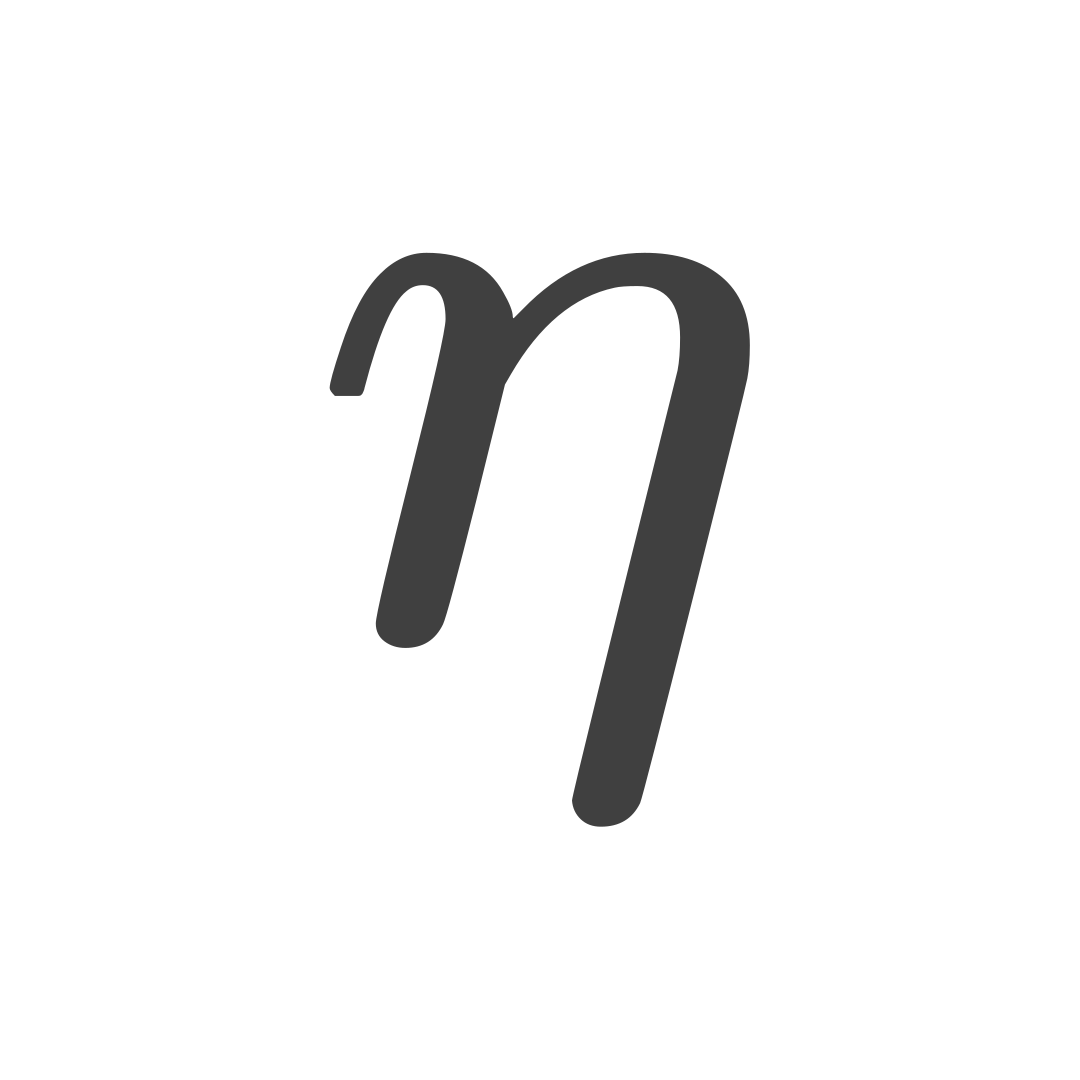
Cartesian or Rectangular Form
A complex number has the form , where is the real part and is the imaginary part. This form is called the Cartesian form or rectangular form.
- (Real Part)
- (Imaginary Part)
We can also view the complex number as an ordered pair on a coordinate plane. This special plane is called the complex plane or Argand diagram.
- The horizontal axis (-axis) represents the real part.
- The vertical axis (-axis) represents the imaginary part.
Visualization on the Complex Plane
Each complex number can be placed at the point in the complex plane. The position vector from the origin to that point represents the same number geometrically.
Polar Form
Besides Cartesian, there's another way to represent complex numbers: the polar form. This form uses:
- Modulus (): The distance from the origin to the point on the complex plane. Its value is always non-negative.
- Argument (): The angle formed by the line from the origin to the point with the positive real axis. This angle is usually measured in radians or degrees.
For , the modulus is , but no direction is defined. Therefore, zero has no argument and must be handled separately when using polar or exponential form.
The relationship between Cartesian form () and Polar form () can be seen from basic trigonometry:
From this, we can find and if and are known:
When finding from , pay attention to the quadrant where the point lies to determine the correct angle.
By substituting and into the Cartesian form, we get the polar form:
Sometimes, the form is abbreviated as .
Conversion to Polar Form
Suppose we have .
- Real part .
- Imaginary part .
Find :
Find :
Since and are positive, the point is in quadrant . The angle whose is in quadrant is or radians.
So, the polar form is:
Polar Form Exercise
Express the following complex numbers in polar form:
Worked solutions:
-
For :
-
Identify and .
-
Calculate the modulus :
-
Calculate the argument :
Since and are positive, the point is in quadrant , so .
-
Polar Form:
-
-
For :
-
Identify and .
-
Calculate the modulus :
-
Determine the argument : The point lies on the negative imaginary axis, so its Principal Argument is .
-
Polar form using the Principal Argument:
The coterminal angle gives the equivalent form
-
Exponential Form
The exponential form follows from Euler's formula:
Here, is Euler's number, the base of the natural logarithm.
If we substitute Euler's Formula into the polar form , we get the exponential form:
For nonzero factors, this form turns multiplication into multiplying moduli and adding arguments. Division uses the corresponding quotient of moduli and difference of arguments.
Conversion to Exponential Form
Take the previous examples:
-
For , we already have the polar form .
-
Modulus .
-
Argument radians.
-
Exponential Form:
-
-
For :
-
Modulus .
-
Argument . Convert to radians:
Or use the negative angle radians.
-
Exponential Form (choose one angle):
or
-
Exponential Form Exercise
Express the following complex numbers in exponential form (use radian angles):
Worked solutions:
-
For :
-
Modulus .
-
Argument . Convert to radians:
-
Exponential Form:
-
-
For :
-
Modulus (because there is no coefficient in front of and ).
-
Argument . Convert to radians:
-
Exponential Form:
-
Choosing a Suitable Form
Cartesian form is usually the clearest choice for addition and subtraction. Polar or exponential form makes multiplication, division, powers, and roots easier because moduli and arguments can be combined directly.
To return from polar form to Cartesian form, evaluate the sine and cosine. For example:
Changing form is a problem-solving choice. The complex number itself stays the same.
Equality of Two Complex Numbers
Two complex numbers and are equal if and only if their real parts are equal and their imaginary parts are equal.
Equality Example
The example below compares two numbers with different real parts but equally large imaginary parts, so the sign of the imaginary part decides the answer.
-
and are different.
because (even though , their imaginary signs differ).
-
and are equal.
because and .
Equality Exercise
Determine if the following pairs of complex numbers are equal or different:
- and
- and
- and
Worked solutions:
-
.
Thus, is equal to .
-
and .
The real parts are different () and the imaginary parts are different ().
The unequal imaginary parts show that is different from .
-
and .
The real parts are different ().
Thus, is different from .
Exercises
Each item asks you to accept or reject a statement about the three standard forms, so name the form before you decide.
- True or False. Every real number is a complex number.
- True or False. The three standard forms used here are Cartesian, exponential, and logarithmic.
- True or False. If the complex number is plotted on the complex plane, it lies in quadrant III.
- Express the complex number in polar and exponential forms.
- Find the numbers and such that and satisfy .
- Find the solutions to the quadratic equation .
- Find the quadratic equation whose solutions are and .
Worked Solutions
-
True. A real number can be written as .
-
False. The three standard forms used here are Cartesian, polar, and exponential. A logarithm is an operation applied to a complex number. It is not one of these three forms.
-
False. has a positive real part () and a negative imaginary part (). The point lies in Quadrant IV.
-
For :
-
Calculate the modulus :
-
Calculate the argument :
Since and (both positive), the point is in Quadrant I. Thus, or radians.
-
Polar Form:
-
Exponential Form:
-
-
For to equal , the real parts must be equal and the imaginary parts must be equal:
- Real Part:
- Imaginary Part: So, and .
-
To solve , use the quadratic formula:
with :
The solutions are and .
-
If the roots of a quadratic equation are and , the equation can be formed from or .
-
Calculate the sum of the roots:
-
Calculate the product of the roots:
-
Construct the quadratic equation:
-