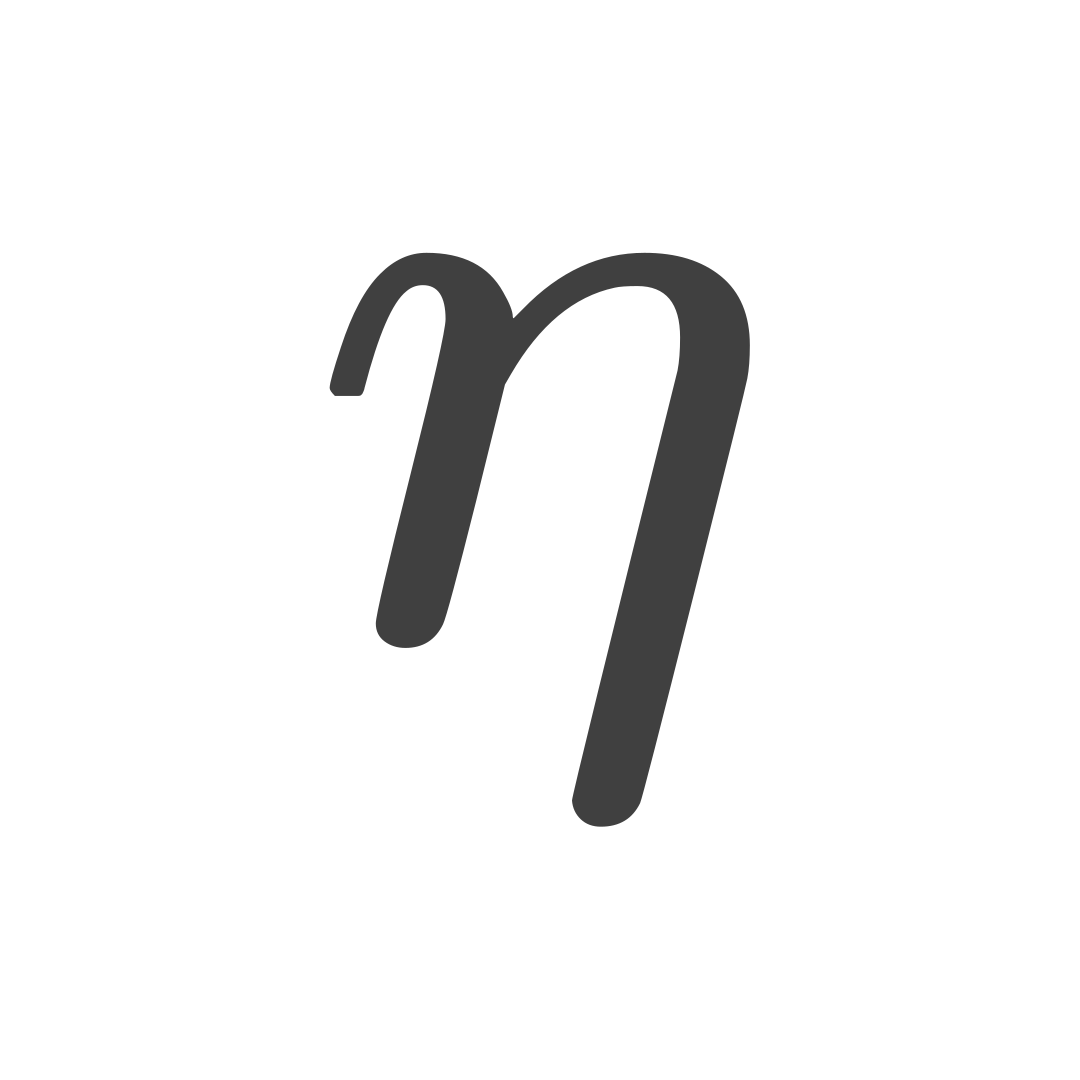
Behavior of a Function and Its Derivative
As we read a graph from left to right, its curve may rise, fall, or briefly become flat. This behavior is called the function's monotonicity, and its first derivative tells us how to classify it.
The sign of the slope tells us the curve's local direction:
-
A positive slope means the function is increasing.
-
A negative slope means the function is decreasing.
-
A zero slope marks a stationary point, although that point need not be a maximum or minimum.
Geometrically, is the slope of the tangent line. Its sign therefore describes the curve's local direction.
Properties of Monotonicity
The relationship between the first derivative and the behavior of a function can be summarized by the following properties:
Suppose the function is continuous and differentiable over an interval.
-
If for all in that interval, then is an increasing function.
-
If for all in that interval, then is a decreasing function.
-
If at a specific point, then has a stationary point there.
Stationary points divide the domain into intervals that we can test. They are candidates for a change in monotonicity, but the derivative must change sign for the function to switch from increasing to decreasing or vice versa.
Analyzing Function Intervals
The following example shows the complete sign-analysis process.
Determine the intervals for which the function is increasing and decreasing.
Solution:
Step 1: Find the first derivative
First, we differentiate the function .
Step 2: Find the stationary points
Stationary points occur when .
From this, we get the stationary points at and .
Step 3: Create a number line and test intervals
We place the stationary points on a number line. These points divide the line into three intervals. We take a test point from each interval to find the sign of (positive or negative).
-
Interval :
Take . (Positive, function is increasing).
-
Interval :
Take . (Negative, function is decreasing).
-
Interval :
Take . (Positive, function is increasing).
Step 4: Conclude the intervals
Based on the tests, we can conclude:
-
The function is increasing on the intervals or .
-
The function is decreasing on the interval .
Exercises
Each problem asks where a function increases or decreases. Find the stationary points first, because they separate the intervals.
-
Determine the intervals where the function is increasing and decreasing for the curve .
-
If is increasing throughout , determine the possible values of .
-
Determine the intervals where is increasing and decreasing.
Answer Key
-
Solution:
The first derivative of is .
Stationary points are found when .
The stationary points are at and .
By testing the intervals on a number line:
-
For , is positive (increasing).
-
For , is negative (decreasing).
-
For , is positive (increasing).
So, the function is increasing on or , and decreasing on the interval .
-
-
Solution:
For this function to increase throughout the interval, it is enough to require at every point in the interval.
In the interval , the factor is always positive. Therefore, for , the second factor, , must also be non-negative.
This inequality must hold for every in . Since is linear, its smallest limiting value occurs toward one end of the interval.
-
If , then , so is positive throughout the interval.
-
If , then decreases. Because is excluded, has no minimum there. Its infimum is the boundary value approached as . Requiring that boundary value to be non-negative gives the exact condition.
Evaluate the limiting boundary condition at :
Combining both cases, the function increases throughout the given interval precisely when .
-
-
Solution:
Use the double angle trigonometric identity: .
So, .
Its first derivative is:
-
The function is increasing when , which is or . This occurs in quadrants and .
This interval is valid for any integer .
-
The function is decreasing when , which is . This occurs in quadrants and .
This interval is valid for any integer .
-