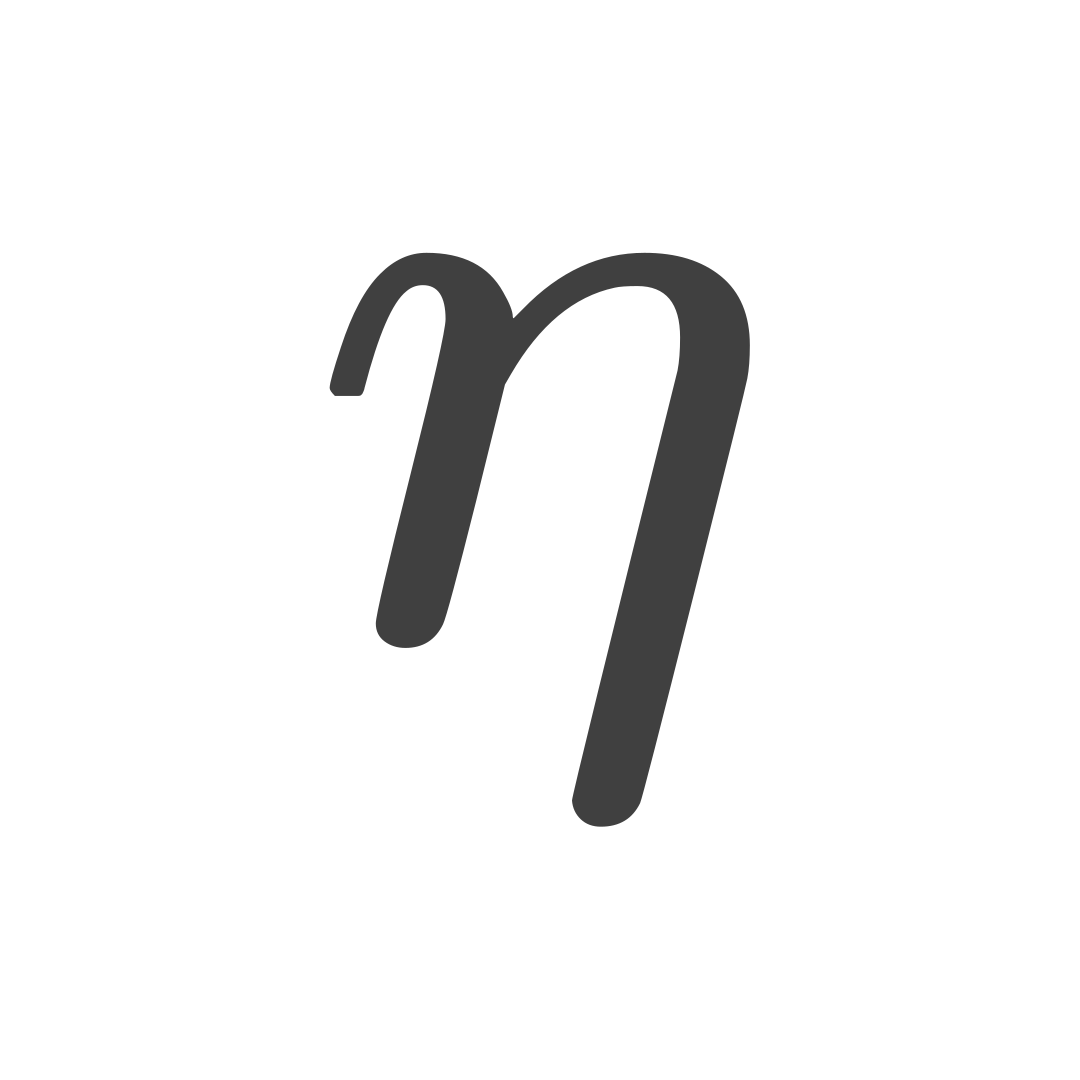
Equations That Hold for Every Permitted Angle
Some equations are true for every permitted value of their variables. For example, holds for all values of and . Such an equation is called an identity.
In trigonometry, an equation that is true for every angle in its domain is a trigonometric identity. An identity rewrites an expression into an equivalent form without changing its value. This is useful when proving another identity or solving an equation.
Basic Trigonometric Identities
Each identity holds for every angle in its domain, so you can replace one side with the other wherever the expression appears. All of them follow from the unit circle, and each one turns a difficult expression into a simpler one.
Pythagorean Identity
Consider a unit circle with point that forms angle with the positive -axis.
On the unit circle:
- Radius:
- The -coordinate is
- The -coordinate is
Using the Pythagorean theorem for point :
Substituting the values of and :
Or can be written as:
This equation is the Pythagorean identity.
Other Forms of Pythagorean Identity:
From the basic identity above, we can derive two other forms:
Second form: Divide both sides by (for )
Third form: Divide both sides by (for )
Reciprocal Identities
Each trigonometric function has its reciprocal. This relationship forms reciprocal identities:
Equivalently:
Each reciprocal identity applies wherever both sides are defined.
Quotient Identities
Quotient identities relate tangent and cotangent to sine and cosine:
The quotient forms likewise require a nonzero denominator.
Both quotient identities follow directly from the definitions of the trigonometric functions on the unit circle.
Even and Odd Function Identities
When angles are negative, trigonometric functions have special properties:
Even function (symmetry about -axis):
Odd functions (symmetry about origin):
Using Identities in Proofs
A proof starts from one side of the equation and rewrites it with known identities until it matches the other side. Write down every step so the identity you used stays visible.
The next examples show how trigonometric identities prove other equations.
Simplifying Expressions
Simplify
Solution:
Use the Pythagorean identity:
Proving Identities
Prove that
Solution:
We start from the left side:
Use :
The left-hand side has become the right-hand side, so the identity holds on their common domain.
Determining Trigonometric Function Values
One known function value determines the others once you know the quadrant of the angle. The examples below pick the identity that gives the missing value directly.
Trigonometric identities determine the remaining trigonometric values from one known value, together with the angle's quadrant or sign information.
Identity Applications
If and (quadrant II), determine the values of other trigonometric functions.
Solution:
Use the Pythagorean identity to find :
Since is in quadrant II, then .
Next, calculate the other trigonometric functions:
Exercises
Each problem asks you to simplify an expression or prove an identity. Convert every function to sine and cosine first, then simplify.
-
Simplify the expression
-
Prove the identity
-
If and , determine the values of all trigonometric functions.
-
Simplify
-
If and , determine the values of and .
Answer Key
-
Simplify the expression step by step:
The result is valid on the original expression's domain, where and .
-
To prove the identity, we will transform the left side:
This proves equality wherever both original sides are defined.
-
Given in quadrant IV.
Finding :
The value is negative in quadrant IV:
Other trigonometric functions:
-
Use difference of squares factoring:
-
Given and .
Since and , then (quadrant III).
Use the identity :
The value is negative in quadrant III:
For :