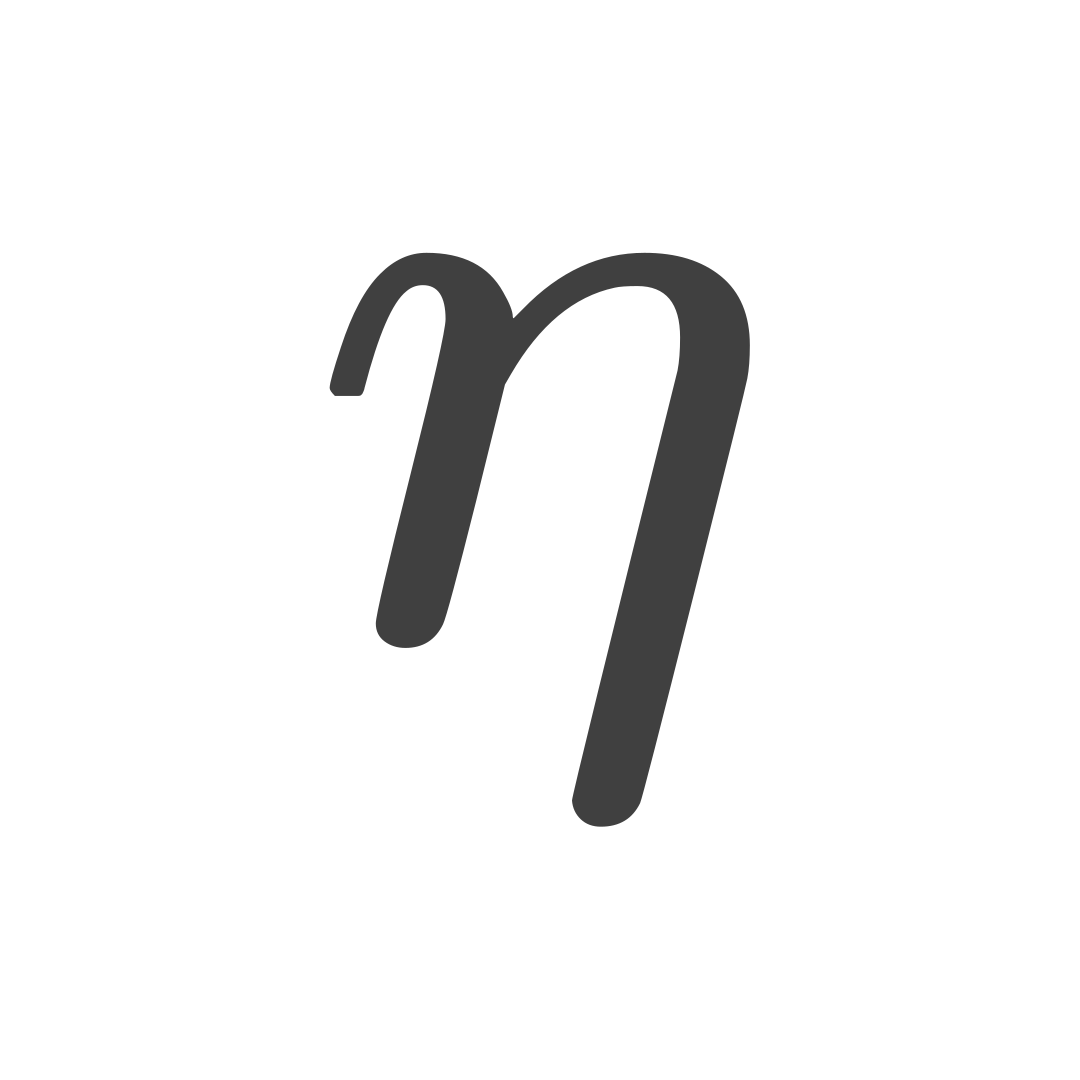
How Reflection Changes the Vertical Coordinate
In a reflection across the -axis, every image point lies on the opposite side of the -axis at the same distance. The -axis acts like a horizontal mirror.
If a point has coordinates , then its reflection, which we'll call , will have the same -coordinate, but its -coordinate will be the negative of the original value.
Mathematically, if the initial point is , then after reflection across the -axis, its image is .
Visualizing Points and Their Reflections
In the point pairs below, the -coordinate stays fixed while the -coordinate changes sign.
Track the coordinates: the -coordinate changes sign, while the -coordinate remains the same.
The plotted pairs show the relationship between each original point (pre-image) and its reflection (image):
- Point becomes
- Point becomes
- Point becomes
- Point becomes
Every pair keeps the same value and changes the sign of its value.
Property of Reflection across the Horizontal Axis
These point pairs give the coordinate rule for reflection across the -axis:
This means the reflection of point across the -axis is . The -axis is the line .
Reflecting Triangles and Lines
Reflecting a figure means reflecting each of its points. A line needs its equation transformed instead, and the examples below do both. For the triangle, transform the three vertices, for the line, substitute the reflection rule into the equation.
Reflecting a Triangle
Determine the image of triangle with vertices , , and reflected across the -axis.
To determine the image of triangle , we apply the reflection property to each of its vertices:
Consequently, the image of triangle is triangle with vertices , , and .
Reflecting a Line
If a line has the equation and is reflected across the -axis, determine the equation of its reflected line.
Solution:
Let an arbitrary point lie on the line . Then, the following holds:
The point reflected across the -axis produces the image .
To obtain the equation of the reflected line, we substitute the coordinates of the image into new variables. Let and .
From this, we get and .
Substitute and into the original equation :
Since and are arbitrary variables representing the coordinates on the reflected line, we can rewrite them as and .
The equation of the reflected line is:
Reflection across the -axis changes into by replacing with .