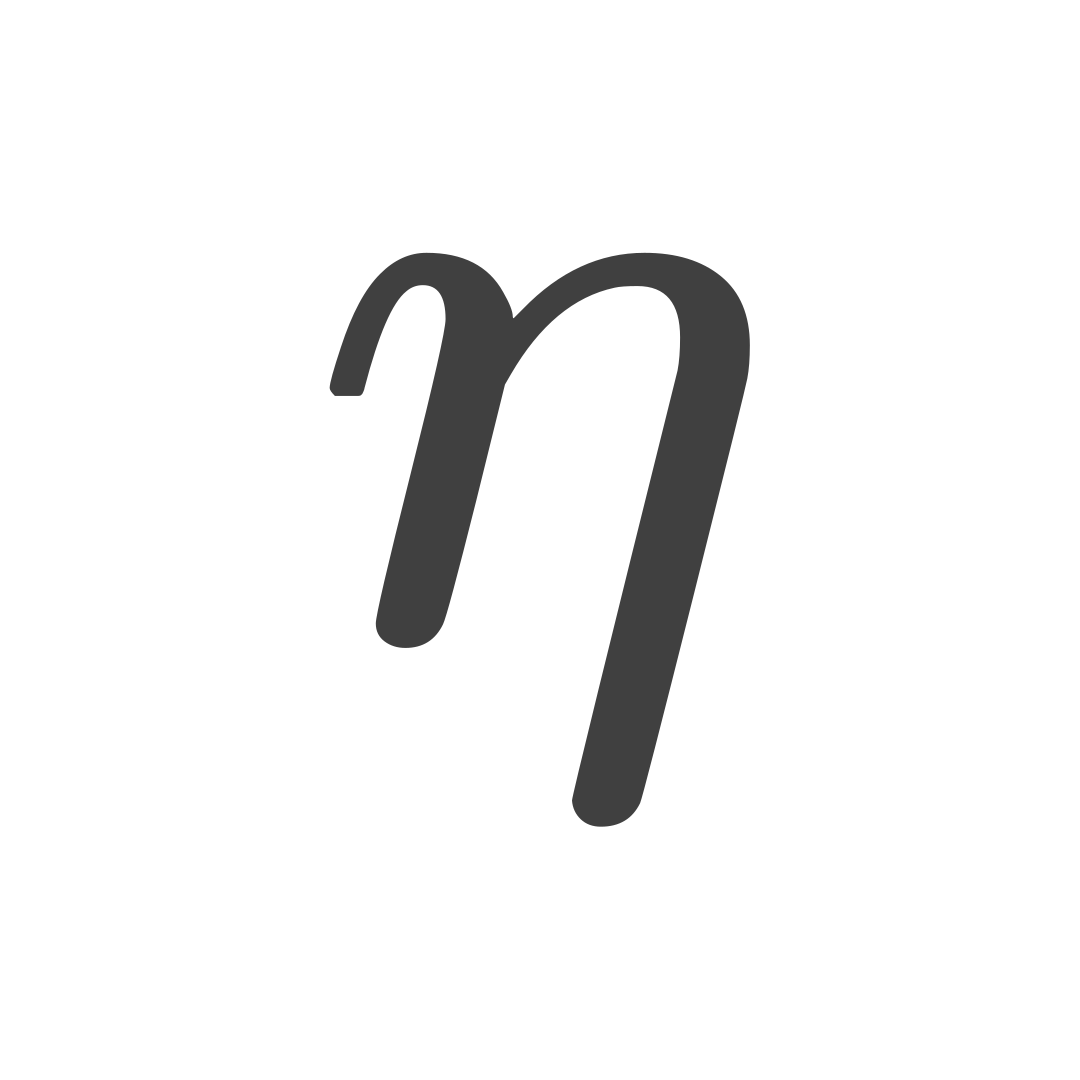
Following Function Values near a Chosen Input
A limit describes how nearby output values behave as the input approaches a chosen point. The function value at that point does not determine the limit. A two-sided limit can exist even if the function value is undefined or different. At a jump, compare the two one-sided limits. Near a vertical asymptote, an infinite limit describes the unbounded behavior.
Continuity, derivatives, and definite integrals are all defined using limits. We will first read the pattern from a value table, then connect it to one-sided limits and the precise epsilon-delta definition.
Approach Through Value Tables
The table below records how changes as approaches from both sides.
| ... | |||||||
|---|---|---|---|---|---|---|---|
| ... |
As approaches from either side, the table values of approach . That approaching value is the limit.
Notation One Sided Limits and Formal Meaning
The standard notation is:
This is read as "the limit of as approaches equals ".
When is an interior point and the function is defined on both sides near , the two-sided limit exists exactly when:
- Left limit and right limit must exist
- Left limit must be equal to the right limit
- The limit value is
More formally, left and right limits can be written as:
For the left limit, approaches from the left:
For the right limit, approaches from the right:
If both limits are equal, then . If they are different, then the two-sided limit does not exist. At an endpoint of a domain, only the one-sided limit from within the domain is relevant.
The precise epsilon-delta definition gives mathematical meaning to "approaches":
In words, for every requested output tolerance , however small, we can choose an input tolerance that keeps within of whenever is within of but not equal to it. The condition is why the value does not determine the limit by itself.
Application of Limits
Limits answer questions about how a quantity behaves near a point. A limit value can differ from the function value at that point, and the two examples show one case where substitution is enough and one where the expression must be simplified first.
Evaluating a Limit by Direct Substitution
Find .
Solution:
Since the function is continuous at , we can directly substitute:
Simplifying an Indeterminate Form Before Taking the Limit
Find .
Solution:
If we substitute directly, we get the indeterminate form . We need to simplify first by factoring:
Since a limit concerns nearby values with , we may cancel before evaluating the simplified expression:
Basic Properties of Limits
Each rule moves the limit operation onto the separate pieces of an expression. Linearity covers sums and constant multiples, the product rule covers multiplication, and the division rule works only while the denominator keeps a nonzero limit.
-
Linearity Property:
-
Multiplication Property:
-
Division Property:
provided
Exercises
The four problems below cover direct substitution, a case that needs factoring, a basic trigonometric limit, and a piecewise function. Solve each one on paper first, then compare your steps with the solutions.
-
Find
-
Find
-
Find (use trigonometric limit theorem)
-
The function is defined by:
Find .
Worked Solutions
-
Solution:
Since polynomial functions are continuous at all points, we can substitute directly:
-
Solution:
Direct substitution yields the form . We factor first:
Since the limit uses nearby values with , we may cancel before evaluating the simplified expression:
-
Solution:
This fundamental trigonometric limit is used to derive the derivatives of sine and cosine. Direct substitution gives the indeterminate form , so we use the trigonometric limit theorem:
Note: Measure in radians. Degrees give a different result.
-
Solution:
For piecewise functions (defined with different rules), we must check left and right limits separately:
Left limit (when approaches from the left, so ):
Right limit (when approaches from the right, so nearby inputs satisfy ):
Since , then does not exist.