Using Known Points or Roots to Determine a Quadratic
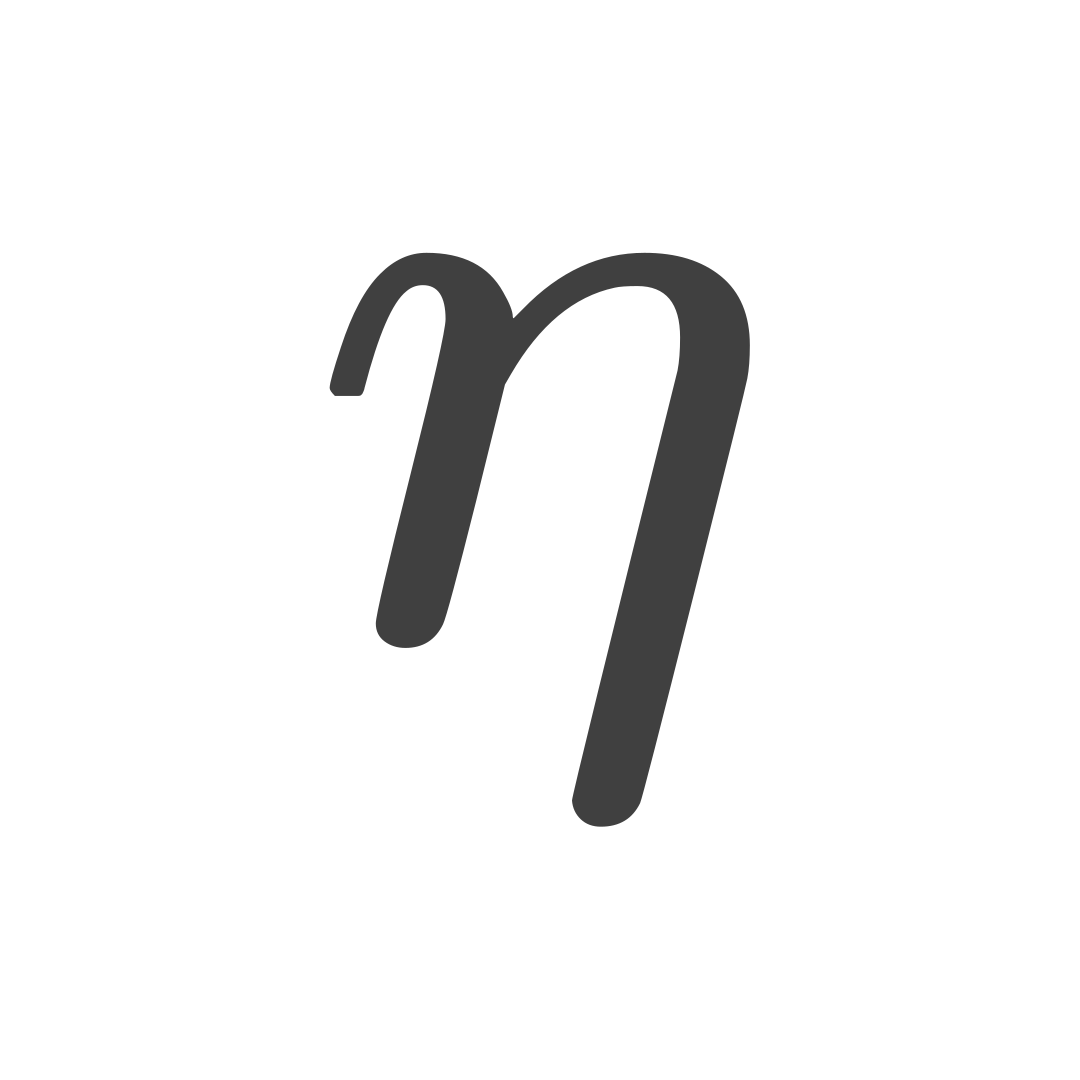
Constructing a quadratic function means determining from the given information. Known points lead to a system for the coefficients, known roots lead to factored form, and a known vertex leads to vertex form.
Forms of Quadratic Functions
- Standard Form:
- Factored Form: when the real roots and exist
- Vertex Form: where is the vertex point
These three forms are interrelated and can be converted from one form to another.
Methods of Constructing Quadratic Functions
Which conditions are given decides which approach reaches the function most quickly. Three points, a vertex with one more point, and the two intercepts each supply exactly the information one of the three forms is built from.
A quadratic function is fixed once enough conditions are known.
Three Points
Three points with distinct -coordinates determine exactly one polynomial of degree at most . It is a quadratic function only when the resulting coefficient satisfies .
If we have three points , , and , we can substitute these values into the standard equation to get three linear equations with three variables , , and .
Example:
Find the quadratic function that passes through points , , and .
Substitute the coordinate values into the standard equation.
Simplify these equations.
Substitute into the first and third equations.
Simplify and add the two equations to find the value of .
Substitute the value of into the equation to find the value of .
The resulting quadratic function is:
Vertex Point
If we know the coordinates of the vertex and another point on the graph, we can use the vertex form to find the value of .
Example:
Find the quadratic function that has a vertex at and passes through the point .
Use the vertex form with and .
Substitute the point to find the value of .
The resulting quadratic function is:
Roots and One Additional Point
If we know the roots (-intercepts) and of the quadratic function, and an additional point on the curve with , , and , we can use the factored form to determine .
Example:
Find the quadratic function that has roots at and , and passes through the point .
Use the factored form with and .
Substitute the point to find the value of .
The resulting quadratic function is:
Choosing a Function from Two Conditions
The axis of symmetry and the discriminant usually allow several quadratic functions. Another piece of information is needed to select one unique function.
Example:
Find a quadratic function with axis of symmetry and discriminant .
From the axis of symmetry , we know that , so .
From the discriminant , we know that .
Substitute into the discriminant equation.
There are many values of and that satisfy this equation, so the data do not determine a unique function. To obtain one example, choose .
With , , and , the resulting quadratic function is:
Symmetric Coordinates
Symmetric points can also determine a quadratic function.
Example:
Determine the quadratic function that passes through the points , , and .
Since the points and have the same -value and are at the same distance from the -axis, the curve is symmetric about the -axis. This means the axis of symmetry is , and the vertex is at .
Use the vertex form with and .
Substitute the point to find the value of .
The resulting quadratic function is:
Transformations Between Quadratic Function Forms
Each conversion takes one algebraic step, and the graph stays the same throughout.
The same quadratic function can be written in standard, factored, or vertex form.
Standard Form to Vertex Form
This conversion needs completing the square, because that step produces the squared bracket . The working below shows every intermediate step.
To convert to vertex form :
- Determine the -coordinate of the vertex:
- Calculate the function value at the vertex:
- Or use the formula:
Standard Form to Factored Form
To convert to factored form over the real numbers, first verify that the discriminant is nonnegative:
-
Determine the roots of the equation using the formula:
-
If and the real roots are and , then:
If , the function has no real roots and cannot be written as a product of real linear factors.
Factored Form to Standard Form
To convert to standard form :
By comparing with the standard form, we get:
Exercises and Solutions
Each exercise gives a set of conditions and asks for the matching function. Build the function, then check that its graph passes through every given point.
Start each solution from the form that fits the given conditions, and fill in the values only after that choice is made. Compare your own approach step by step with the approach in the worked solution, so that a wrong final value still shows which step differs.
First Exercise
Find the quadratic function that passes through the points , , and .
Answer:
Substitute the points into the standard equation:
From the second equation, . Substitute into the first equation, then solve:
Substitute into the third equation:
Then:
The quadratic function is:
Second Exercise
Determine the quadratic function that has a vertex at and passes through the point .
Answer:
Use the vertex form with and :
Substitute the point :
The quadratic function is:
Third Exercise
Determine the quadratic function that has roots at and , and has a maximum value of .
Answer:
Use the factored form with and :
Since the function has a maximum value, .
The vertex is at .
Substitute into the factored form and use the fact that the maximum value is :
The quadratic function is: