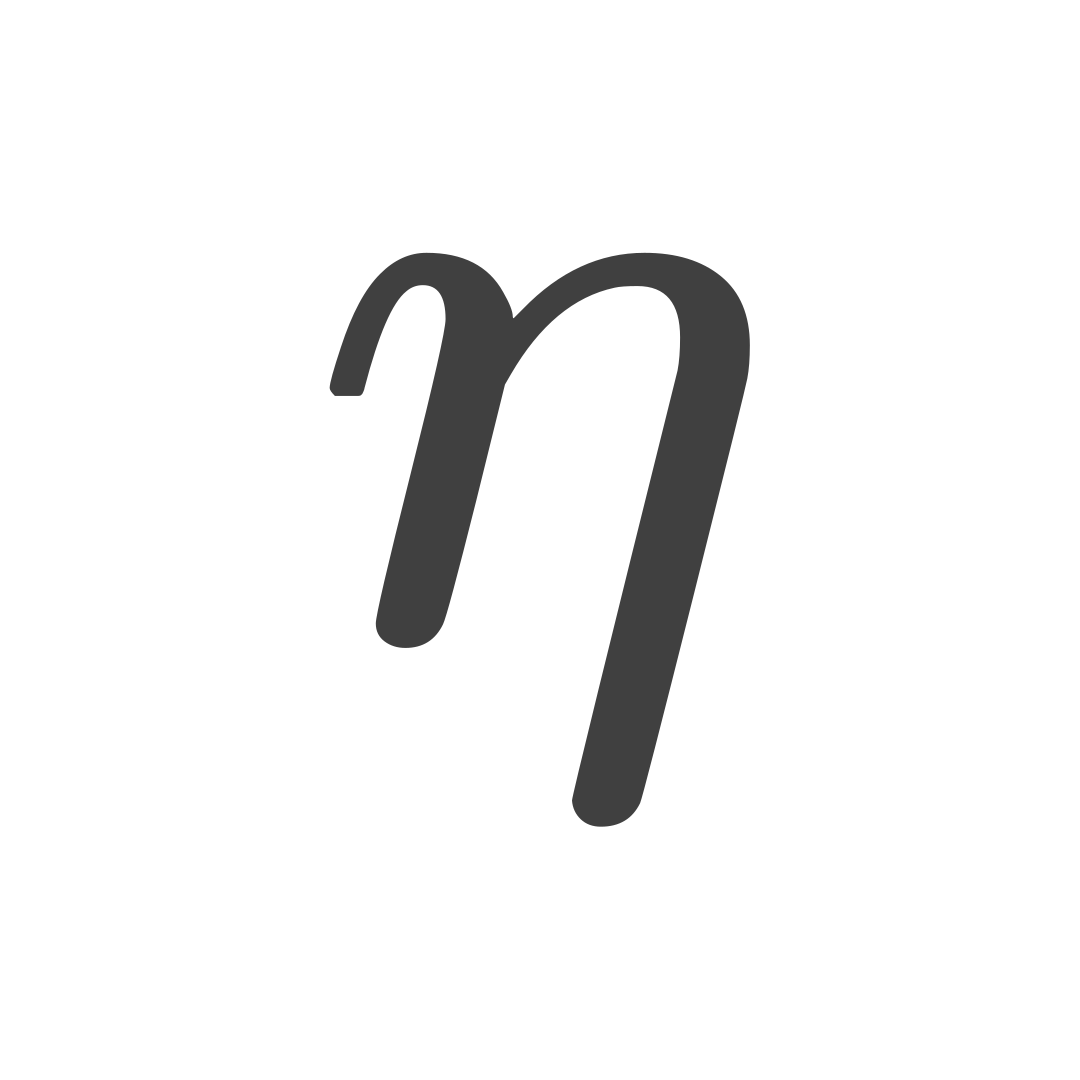
Equal Vectors at Different Starting Points
Two vectors are equal, or represented by equivalent directed segments, when their components are equal. For nonzero vectors, this is the same as having equal magnitude and the same direction. For vectors and , we write .
Equivalent vectors can have different positions in a plane or space, but they maintain the same magnitude and direction.
Conditions for Equivalent Vectors
Two vectors are equal only when both conditions hold at the same time, so check both before you call them equal. A pair that satisfies only one of the two conditions is not equivalent.
Two nonzero vectors and are equal if:
- Both vectors have equal length:
- Both vectors have the same direction
Representation of Equivalent Vectors
Two vectors are equivalent when they share the same length and the same direction, so either one can stand in for the other. That replacement moves a vector to a convenient starting point without changing the vector itself.
In Component Form
In a two-dimensional Cartesian plane, two vectors and are equivalent if:
This equality holds exactly when and .
In three-dimensional space, vectors and are equivalent if:
This equality holds exactly when , , and .
In Terms of Initial and Terminal Points
If vector has initial point and terminal point , then the vector can be expressed as:
Two vectors and are equivalent if:
In this equation, is the initial point and is the terminal point of .
Rules That Follow from Vector Equality
Each of the three rules keeps the endpoints of a chain and removes one repeated vector, so a long list collapses into a single relation. Intermediate vectors can be left out without changing the statement.
Equality of vectors behaves like equality of numbers. The three rules below let a chain of equivalent vectors be shortened.
Reflexive Property
Every vector is equivalent to itself.
Symmetric Property
If vector is equivalent to vector , then vector is also equivalent to vector .
Transitive Property
If vector is equivalent to vector and vector is equivalent to vector , then vector is equivalent to vector .
Checking Equivalent Vectors from Their Components
Two vectors are equivalent when the change in the first coordinate matches and the change in the second coordinate matches. The examples below compare those changes directly.
Equality from Matching Component Changes
Vector with and is equivalent to vector with and .
Proof:
Since , vector is equivalent to vector .
Equivalent Vectors with Different Starting Points
Vector with and is equivalent to vector with and .
Proof:
Since , vector is equivalent to vector .
Why Starting Points Can Differ
Equivalent vectors have the same magnitude and direction even when their starting points differ. The same displacement can therefore be drawn at different positions without changing the vector. This is useful when comparing translations or moving a vector within a geometric construction.