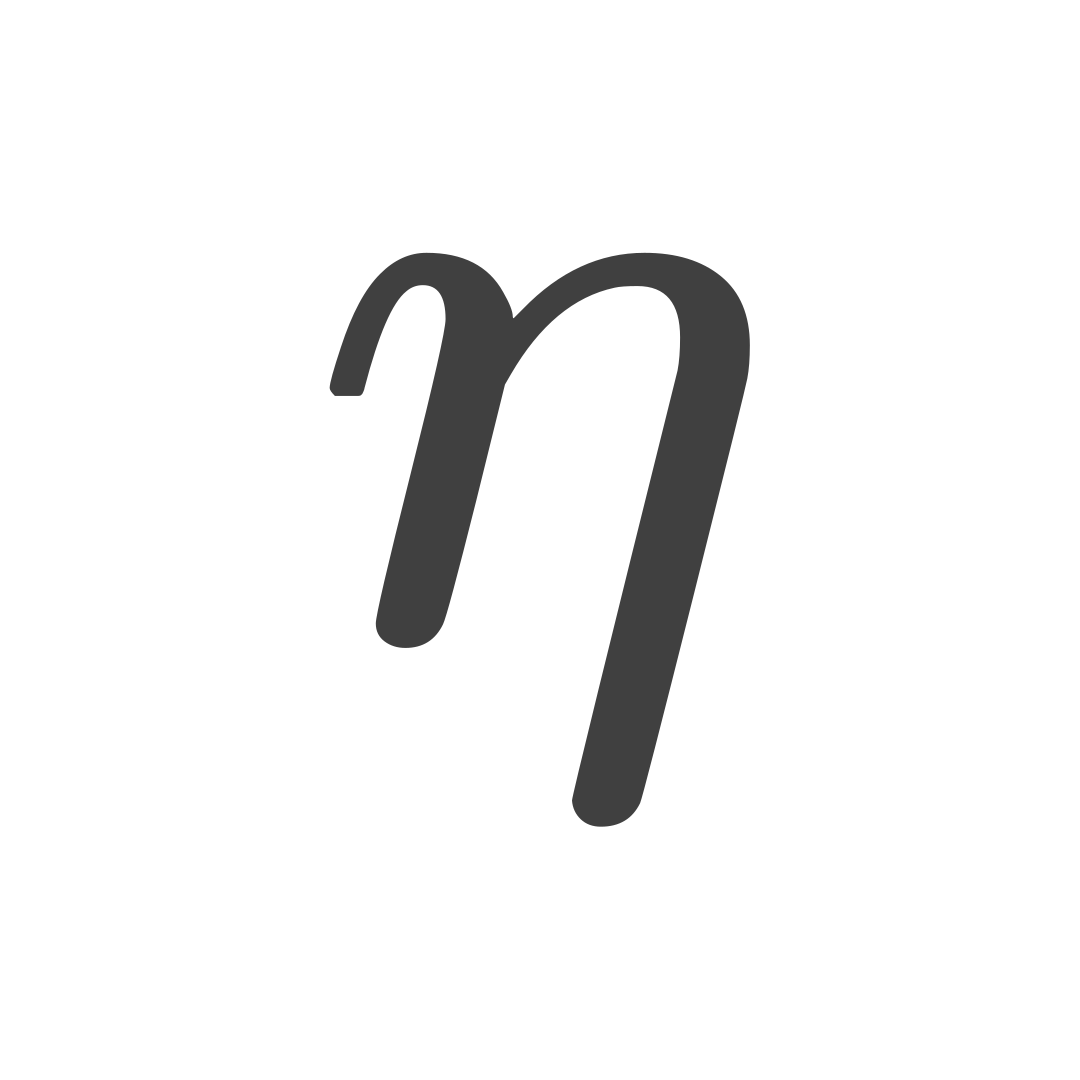
When Two Vectors Form an Angle
If two vectors point in the same direction, their resultant is a simple sum. If they point in opposite directions, their resultant is a difference. Many forces and displacements, however, form an angle with each other. In that situation, the resultant magnitude can be found using the cosine rule.
This rule is used when the magnitudes of two vectors and are known, and the included angle between them is known.
Angle in the cosine rule is the angle between the two vectors when their tails are placed together.
The Cosine in the Triangle Formula
The cosine rule appears because the resultant of two vectors forms a triangle with two known sides. If the angle between the vectors is small, the vectors reinforce each other more strongly. If the angle approaches , they cancel each other more.
The table below shows how changes with the angle :
| Included angle | Value of | Physical meaning |
|---|---|---|
| vectors point the same way and fully reinforce | ||
| vectors are perpendicular | ||
| vectors point in opposite directions |
When , the cosine rule becomes the Pythagorean form because .
Resultant of Two Forces
Two forces act at one point. The first force is , the second force is , and the angle between them is . Find the resultant magnitude.
Use the formula:
The angle between the two forces makes the resultant less than . Since the forces still point in fairly similar directions, the resultant is greater than either force on its own.
Checking with Boundary Cases
Boundary cases help check whether an answer is reasonable. If the angle is , the formula should give .
If the angle is , the formula should give the difference of the magnitudes.
This check shows that the cosine rule is connected to the simpler same-direction, opposite-direction, and perpendicular-vector cases.
When to Choose the Cosine Rule
All of the following must hold:
- there are only two vectors.
- both vector magnitudes are known.
- the included angle is known.
- the question asks for resultant magnitude.
For more than two vectors, resolve every vector into coordinate components and add all and components. The cosine rule applies directly when exactly two vector magnitudes and their included angle are known.