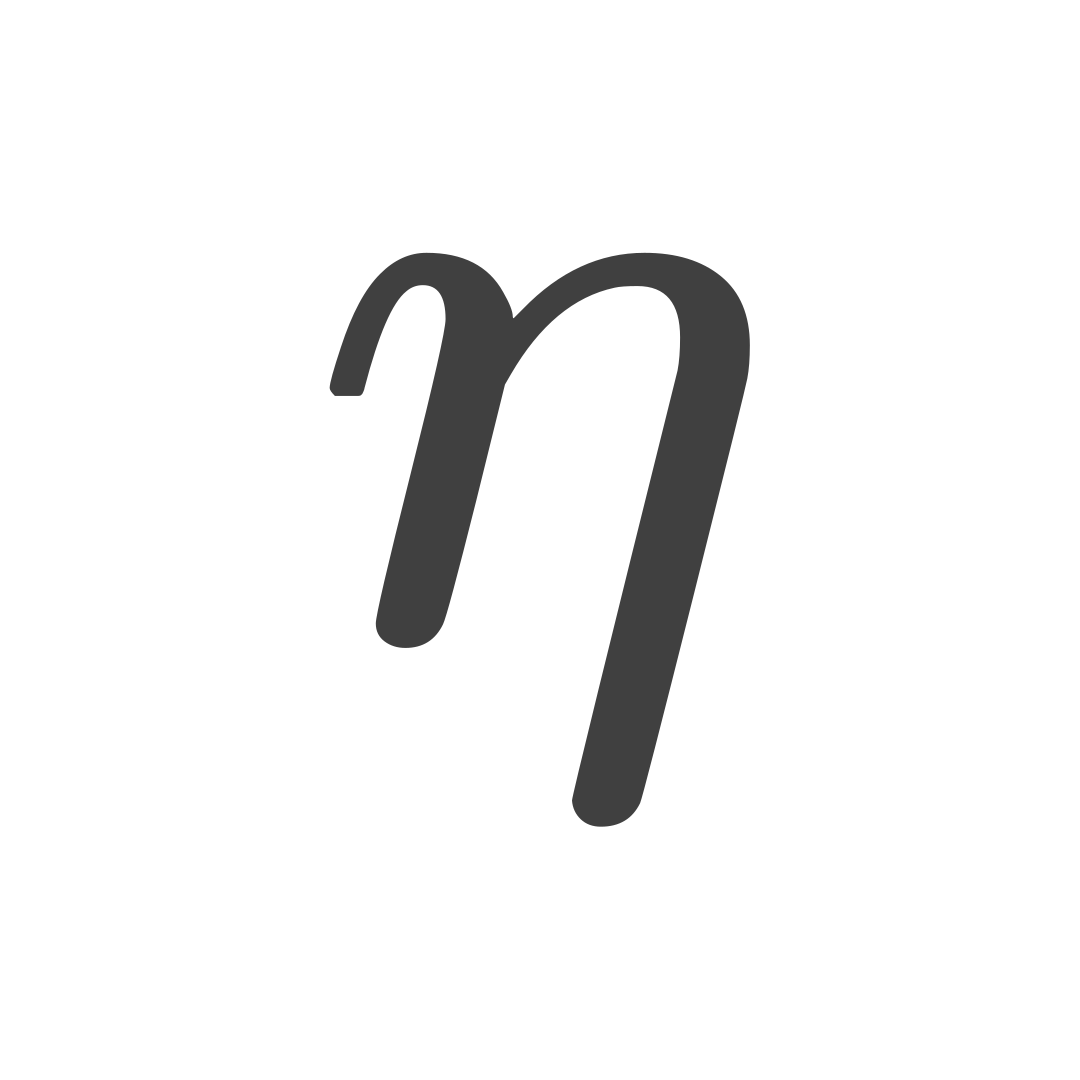
Two Kinds of Vector Multiplication
Vector multiplication does not always produce another vector. Two kinds of multiplication are common in physics: the dot product and the cross product.
The dot product produces a scalar. The cross product produces a new vector whose direction is perpendicular to the two original vectors.
| Type of multiplication | Symbol | Result | Physics example |
|---|---|---|---|
| dot product | scalar | work | |
| cross product | vector | torque |
The multiplication sign changes because the physical question changes: how much is in the same direction, or how strong is the turning effect.
Dot Product Measures the Same Direction Part
The dot product of and is defined as:
Angle is the angle between the two vectors. The result is a scalar, so it has a value without a direction.
In physics, work done by a force can be written as:
This means only the component of force along the displacement actually does work.
Work from Dot Product
A person pulls a box with a force while the box moves . The force makes a angle with the displacement direction. The work is:
If the force is perpendicular to the displacement, and . In that case, the force does no work in the displacement direction.
In other words, the dot product selects the part of the force that actually points along the displacement. A component that only presses upward or downward does not add work along the horizontal displacement.
Cross Product Measures Turning Effect
The cross product of and has magnitude:
The result is a vector perpendicular to the plane containing and . Its direction is determined by the right-hand rule.
In this visual, points along the positive axis and points along the positive axis. The cross-product formula gives the positive direction for . The arrow for is scaled down to fit the scene, but its direction still comes from the calculation.
For torque, the cross product is written:
Vector is the position vector from the rotation axis to the point where the force acts. The perpendicular lever arm has length . At the same angle, the same force produces a larger torque when applied farther from a door hinge.
Torque from Perpendicular Force
A door is pushed with a force at a distance of from the hinge. The force is perpendicular to the door, so .
For fixed and , a perpendicular force gives the maximum torque because . A force almost parallel to the door gives little torque because its sine factor is close to zero.
Comparing Dot and Cross Products
The main difference can be seen from the angle. The dot product is largest when two vectors point the same way because . The cross product is zero in that same condition because .
| Angle condition | ||
|---|---|---|
| maximum | zero | |
| zero | maximum | |
| negative | zero |
So the dot product is useful for asking about alignment, while the cross product is useful for perpendicular effects such as rotation.