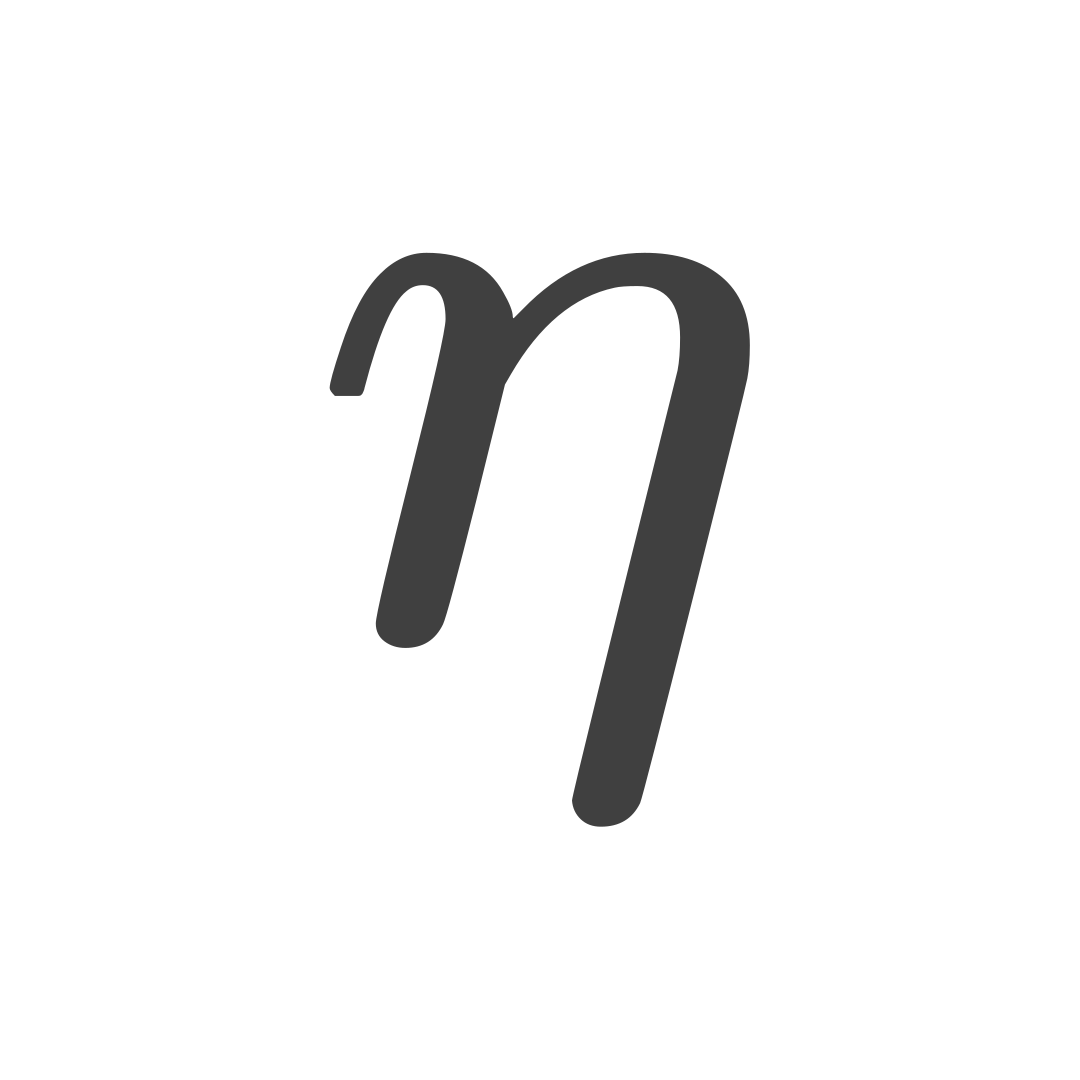
Equal Vectors Do Not Depend on Location
Two vectors are equal if they have the same magnitude and the same direction. Their positions in a diagram may be different. This equality compares the vectors themselves. For a force, its point of application can still change the physical turning effect even when the force vector is unchanged.
Two vectors are equal when their lengths and directions match. Their starting points may differ.
In the visual, and appear at different positions. They are still equal because both have the same magnitude and direction.
This freedom to slide an abstract vector in a diagram does not mean every physical application point is interchangeable. A force applied at a different point may produce a different torque.
A Negative Vector Reverses Direction
The negative of is written as . It has the same magnitude as , but points in the opposite direction.
For example, a force to the right and a force to the left form an opposite-vector pair. If both act on the same object along the same line, their resultant can be the zero vector.
Scalar Multiplication Changes Magnitude and Direction
A scalar is an ordinary number with no direction. When a vector is multiplied by a scalar , the vector length changes by a factor of .
| Form | Result magnitude | Result direction |
|---|---|---|
| twice | same as | |
| half of | same as | |
| three times | opposite to | |
| becomes the zero vector |
A negative scalar does not make the magnitude negative. It reverses the vector direction.
The Zero Vector as Cancellation
The zero vector is written as . Its magnitude is , and its direction is undefined because the tail and tip coincide.
The zero vector often appears when vectors cancel each other. For example, two students may pull a box with equal forces in opposite directions. If the forces are exactly along the same line, their combination does not produce a net push to the right or to the left.
In equilibrium, an object can remain at rest while several forces act on it because their resultant is zero.