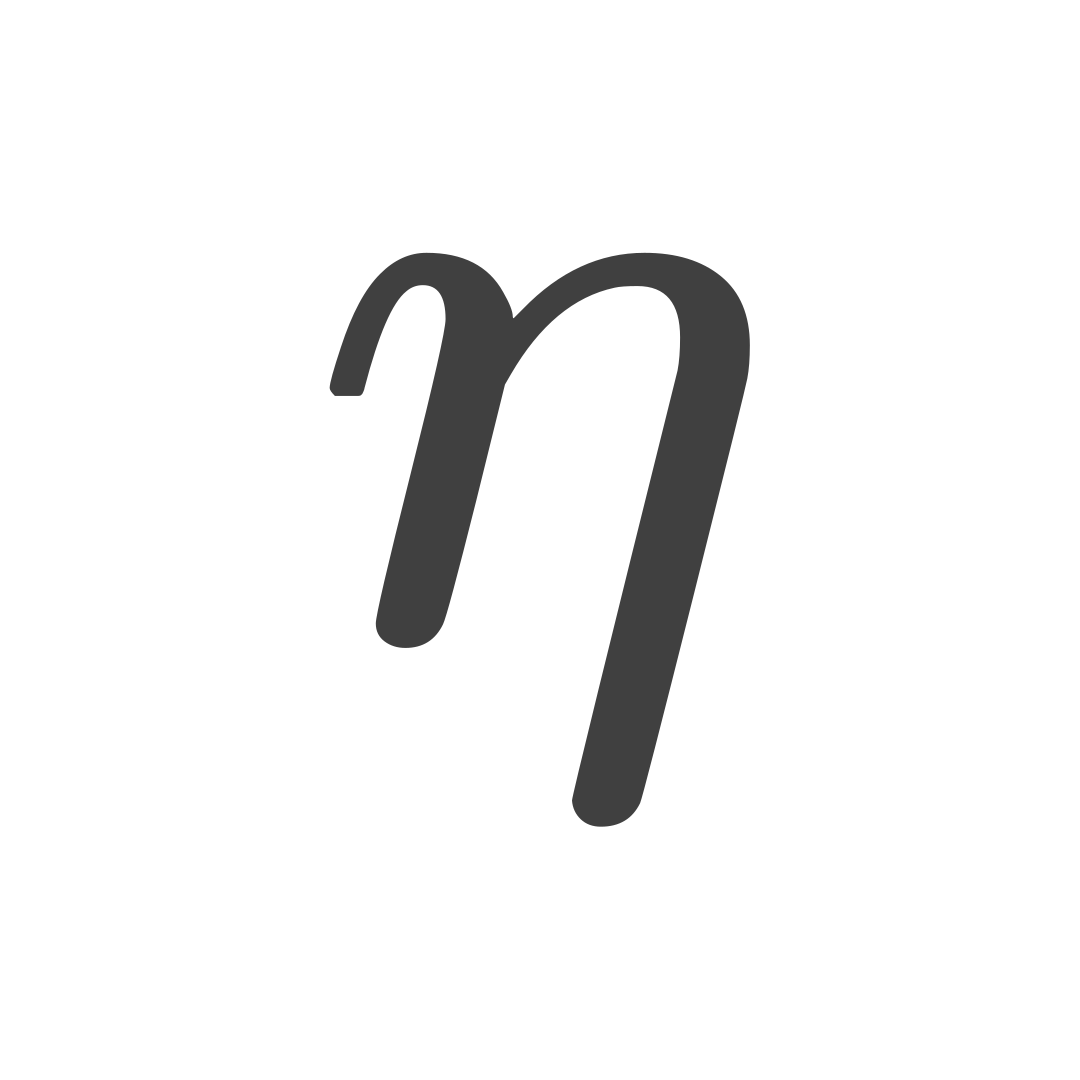
How Operations Affect the Modulus
Let and be complex numbers. The modulus measures the distance of a number from the origin, so every rule about it answers one question: how does that distance change when the number is negated, conjugated, subtracted, multiplied, or divided?
Modulus Under Negation and Conjugation
Negation and conjugation leave the modulus of a complex number unchanged.
Explanation:
Recall that if , then and .
All three yield the same value.
Modulus of Difference
The modulus of the difference of two complex numbers is the same if the order is reversed.
Explanation:
This is a direct consequence of the property. We know . Then:
Square of Modulus
The square of the modulus of a complex number is equal to the complex number multiplied by its conjugate.
Explanation:
If , then .
We also know that , so .
Both sides are equal.
Modulus of Product
The modulus of the product of two complex numbers is equal to the product of their individual moduli.
This follows from multiplying each number by its conjugate:
Both moduli are non-negative, so taking the square root gives the product rule.
Modulus of Quotient
The modulus of the quotient of two complex numbers is equal to the quotient of their individual moduli (provided the denominator is non-zero).
The quotient rule follows from the product rule because when .
Triangle Inequality
The modulus of the sum of two complex numbers is less than or equal to the sum of their individual moduli.
Explanation:
Geometrically, place the vectors and head to tail. The direct vector from the starting point to the endpoint is , and its length cannot exceed the sum of the other two side lengths.
Reverse Triangle Inequality
The difference between the moduli of two complex numbers cannot exceed the distance between the numbers themselves.
This inequality provides a lower bound for a distance or sum. For example, replacing with gives .
Using Modulus Properties
Suppose we are given the complex number . Find .
Solution:
We can view with and .
Using the Modulus of Quotient property:
Now we calculate the moduli of and :
The calculation gives:
The quotient rule avoids expanding the fraction with the conjugate of the denominator before calculating its modulus.
Exercise
Each item asks for a modulus, so write the real and the imaginary part first and then evaluate the square root.
- If and , calculate using the modulus properties.
- If , prove that .
- If and , determine the possible bounds for .
Worked Solutions
-
We use the property .
Calculate each modulus:
Then:
-
Given .
Calculate the left side ():
Calculate the right side ():
The conjugate of is .
Since the left side () equals the right side (), the statement is proven.
-
The ordinary and reverse triangle inequalities give an upper and a lower bound:
Substituting the known moduli gives . The exact value depends on the angle between the two complex numbers.