From Approximation to Exact Area
In the Riemann Sums material, we approximated the area under a nonnegative curve with rectangles. As the partition becomes finer, the corresponding Riemann sums approach a common value for an integrable function.
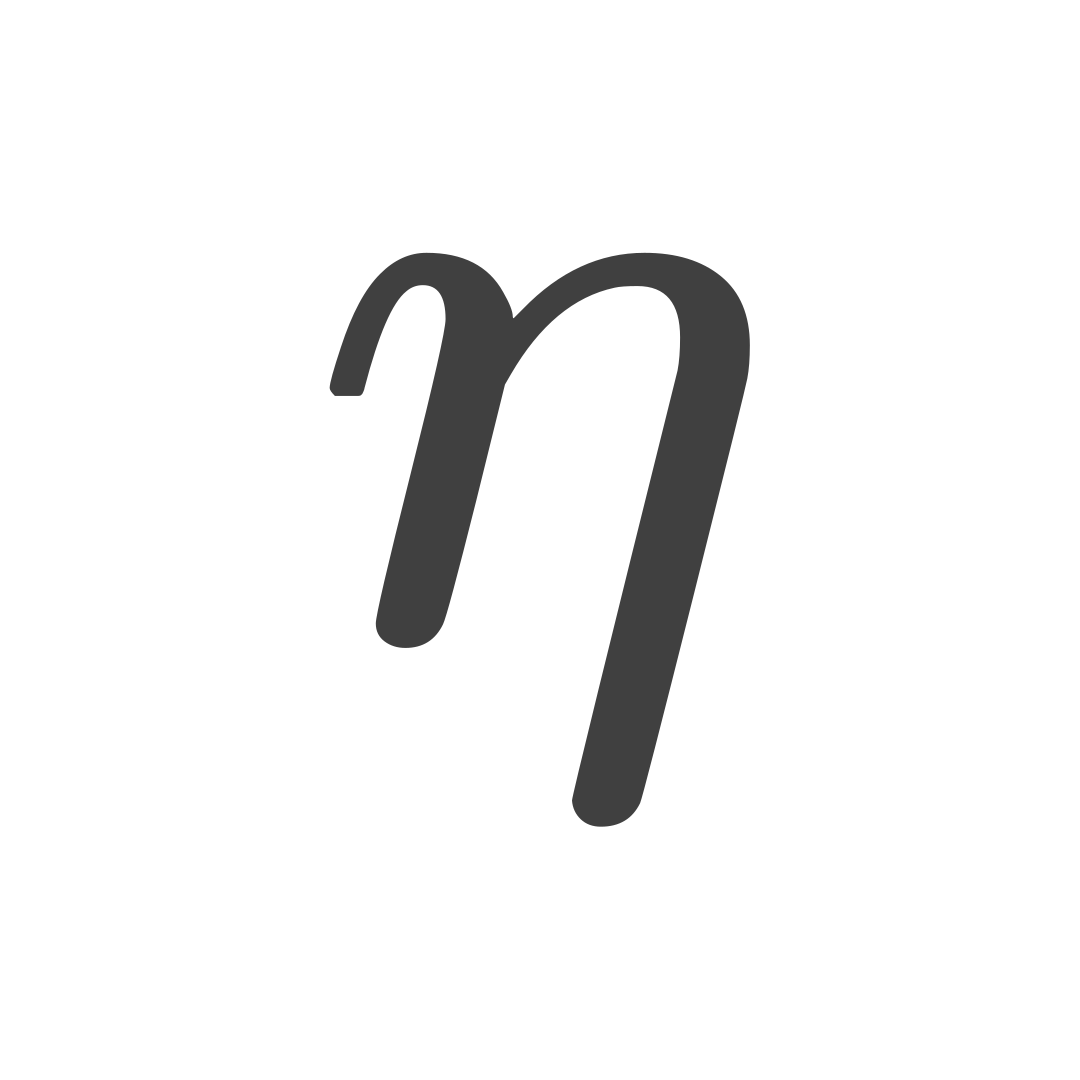
For an equal-width partition, let the number of subintervals grow without bound. Their width then approaches zero. The essential condition is that the mesh width tends to zero. If the Riemann sums have a limit, that limit is the definite integral.
Notation and Meaning of the Definite Integral
The definite integral records this limiting accumulation. It is defined as the limit of Riemann sums, provided that the limit exists.
This notation has a specific meaning:
- : This is the integral symbol with a lower limit and an upper limit . These numbers define the interval over which we are calculating the area.
- : This is the . Its values throughout determine the signed accumulation.
An indefinite integral includes every function of the form . A definite integral gives a single number that measures signed accumulation from to . This number equals ordinary geometric area when the integrand is nonnegative throughout the interval.
Calculating the Definite Integral with Limits
Problem: Determine the value of .
Solution:
To solve this, we will convert it back to the limit form of a Riemann Sum.
Step 1: Determine the Riemann Sum components
From the problem , we know:
- Function:
- Interval:
The width of each subinterval is:
We will use the right endpoint () as the sample point for each partition:
Step 2: Set up the Riemann Sum
The height of each rectangle is , so:
Now, we plug this into the Riemann Sum formula:
Step 3: Simplify and use summation properties
We can factor constants out of the sigma notation, as is treated as a constant in the sum from to .
Next, replace with and simplify until the term that depends on is isolated.
The algebra reduces the expression to a constant factor multiplied by . The remaining limit follows from .
To solve the limit of a Riemann Sum, we often need some common series summation formulas:
Step 4: Take the Limit
Finally, we take the limit as . In this limit, approaches zero.
Because is nonnegative from to , the definite integral is also the geometric area: , or square units. The limit has turned the rectangle approximations into an exact value.