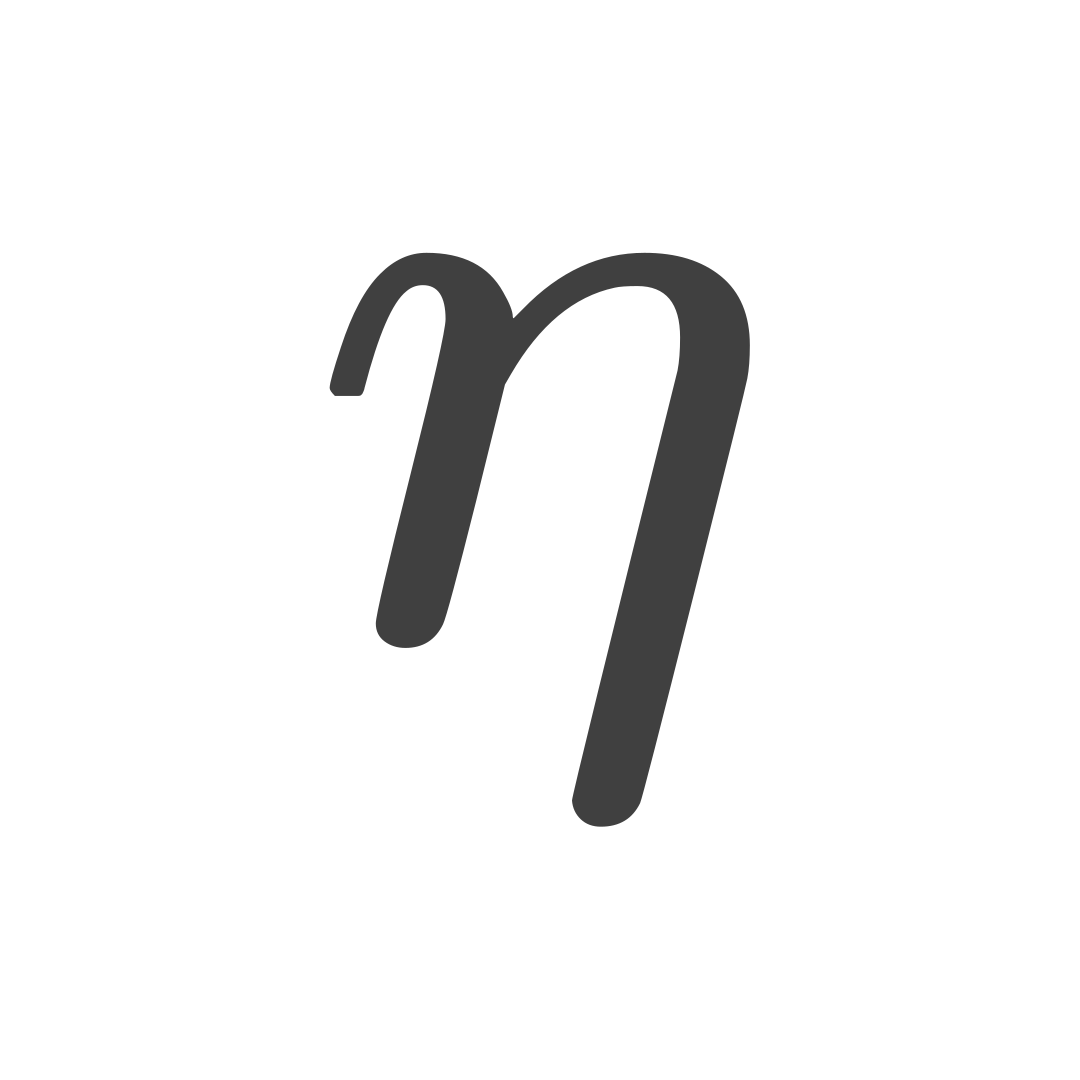
Measuring Spread with Variance and Standard Deviation
Variance averages the squared distances from the mean. Standard deviation takes the square root of that average, returning the measure to the original unit of the data.
- A small variance or standard deviation means the observations cluster close to the mean.
- A large value means the observations are spread farther from the mean.
Formulas for Variance and Standard Deviation
-
Variance ()
Subtract the mean from each observation, square every difference, and average the squared differences.
The formula is:
where:
- = population variance
- = observed value
- = arithmetic mean
- = number of observations
- = sum of all indicated terms
-
Standard Deviation ()
Standard deviation is the square root of variance. Unlike variance, it has the same unit as the original data.
The formula is:
These formulas use the population symbols and divide by the full count. A sample requires the corresponding sample-variance formula.
Comparing Variance in Two Age Groups
Consider two groups of age observations. Both have the same mean (), namely , but their spreads are very different.
- Group One (): , , , , , , , , , , ,
- Group Two (): , , , , , , , , , , ,
We will calculate the population variance and standard deviation of each group.
Calculation for Group One
Calculate for every observation in Group 1, where :
- ()
- ()
- ()
Add the squared differences :
Calculate the variance:
Calculate the standard deviation:
Calculation for Group Two
Repeat the calculation of for Group 2, again with :
Add the squared differences :
Calculate the variance:
Calculate the standard deviation:
Interpreting the Results
- The variance of Group 1 () is much smaller than that of Group 2 ().
- The standard deviation of Group 1 () is also much smaller than that of Group 2 ().
The observations in Group 1 are tightly clustered around the mean of . The observations in Group 2 are much more widely spread around the same mean of .
Alternative Formula for Variance
The following equivalent formula uses the two sums and , which a calculator or program can accumulate directly:
First average the squared observations by dividing their sum by . Then subtract the square of the mean .
Use this formula to recalculate the variance of Group 1:
-
Calculate for Group 1:
-
Calculate for Group 1:
We also know .
-
Plug into the alternative formula:
The result matches the first method exactly: .