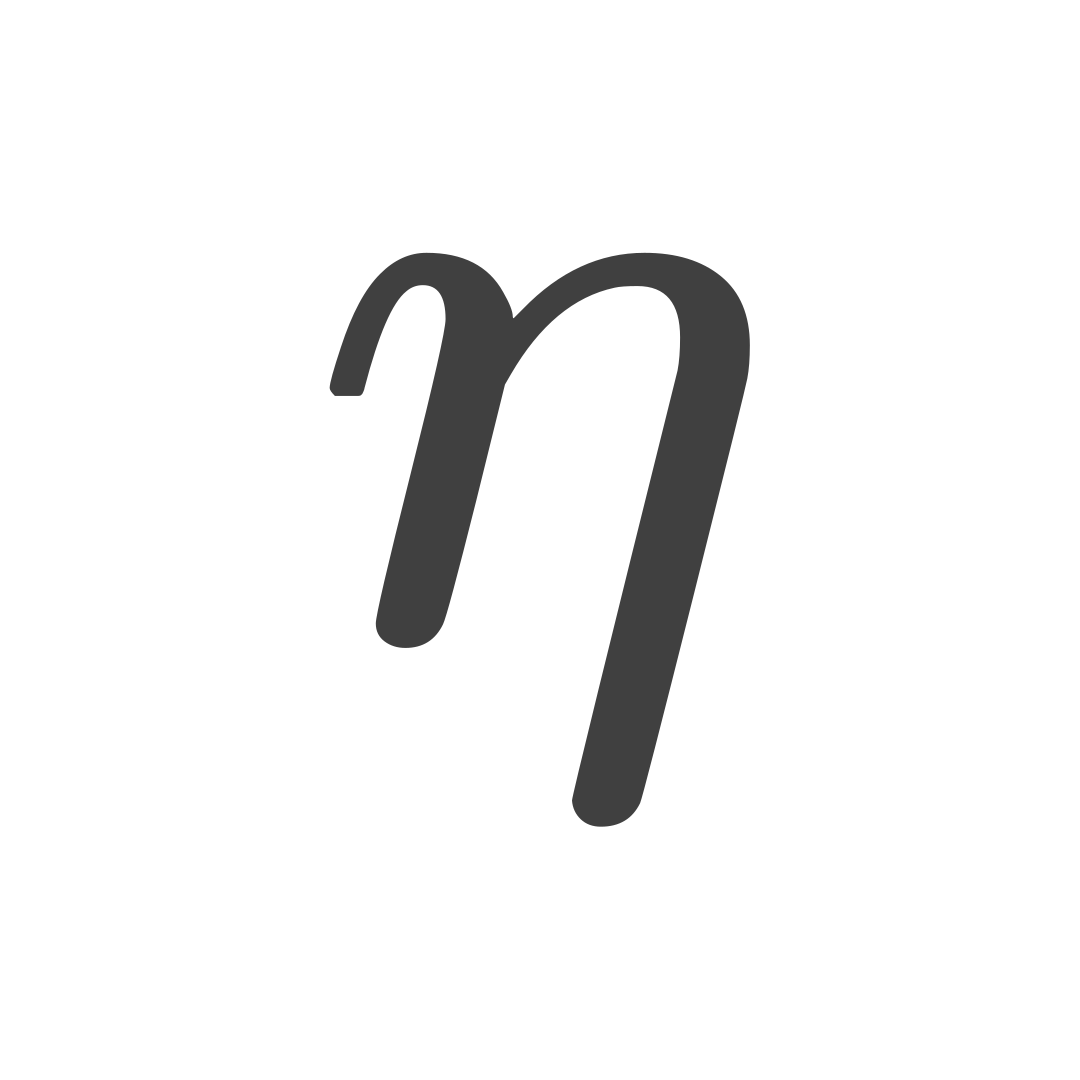
Reversing a Vector without Changing Its Length
For a nonzero vector , its opposite vector has the same magnitude but points in exactly the opposite direction. It is written as .
If describes a displacement from left to right, then describes an equally long displacement from right to left. Their lengths match, and their directions are opposite.
Formula for an Opposite Vector
Multiplying a vector by the scalar reverses every component:
If , then:
Here:
- is the original vector.
- is its opposite vector.
- The factor reverses the direction without changing the magnitude.
Finding the Opposite of a Vector
Suppose .
Its magnitude is:
Multiply every component by to find the opposite vector:
Both vectors have magnitude , but their directions differ by .
Properties of Opposite Vectors
-
Their magnitudes are equal:
-
For a nonzero vector, their directions differ by .
-
Their sum is the zero vector:
-
Taking the opposite twice returns the original vector:
The zero vector is its own opposite because .
Applications of Opposite Vectors
Opposite vectors appear whenever a direction is reversed:
-
Displacement: a return trip along the same straight path has the opposite displacement vector.
-
Force equilibrium: two equal forces in opposite directions add to the zero vector.
-
Vector equations: subtraction can be rewritten as addition of an opposite vector, .
Unit Vectors and Opposite Direction
A unit vector is built from a nonzero vector by dividing that vector by its length. Multiplying the result by reverses its direction while keeping the same line.
Unit Vector
For a nonzero vector , its unit vector is:
It has magnitude and points in the same direction as .
Relationship with the Opposite Vector
The unit vector in the opposite direction is . Multiplying it by the original magnitude gives the opposite vector:
This separates the two ideas clearly: determines the length, while determines the opposite direction.