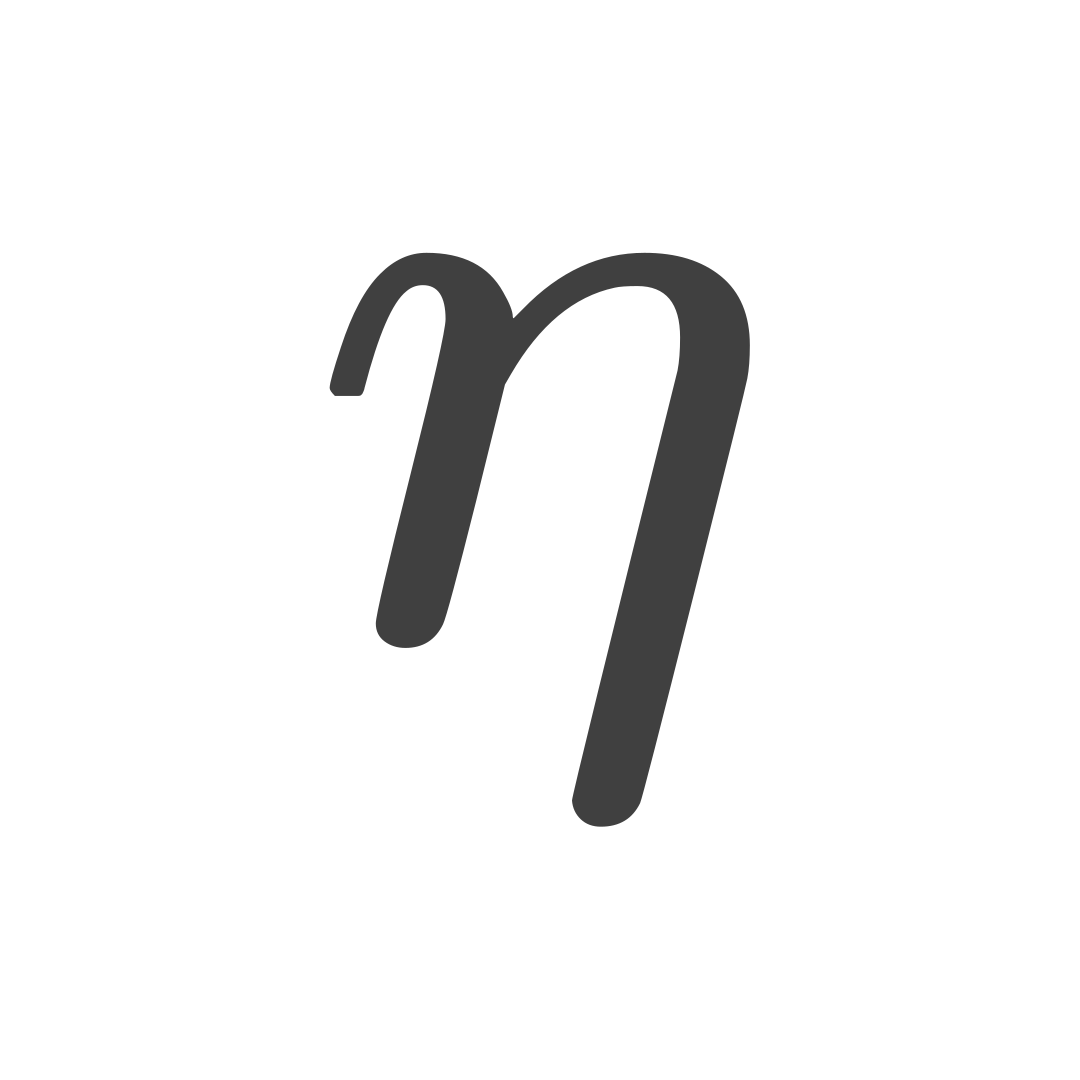
Resolving a Vector along the Coordinate Axes
Every vector in the coordinate plane can be decomposed along the two coordinate axes. In , the signed numbers and are the scalar components. The vectors and are the corresponding vector components, or orthogonal projections onto the axes.
The scalar components tell us how far and in which signed direction the vector extends along the - and -axes. Every vector in the plane is a linear combination of the unit vectors and .
If we have a vector , then:
The components in this form are:
- is the horizontal scalar component, and is the corresponding vector projection
- is the vertical scalar component, and is the corresponding vector projection
- is the unit vector in the direction of the -axis
- is the unit vector in the direction of the -axis
Example of Vector Components
Consider the vector in the diagram. This vector can be written as:
This means that has scalar components and , with vector projections to the right and upward.
Vector Magnitude from Its Components
When we know the components of a vector, we can calculate the length or magnitude of the vector using the Pythagorean theorem.
The magnitude of vector is denoted by and calculated using the formula:
In this formula, and are the components of .
Example of Vector Magnitude Calculation
For the vector , its magnitude is:
Vectors in Three Dimensional Space
Vectors can be used on a two-dimensional plane and in three-dimensional space.
In three-dimensional space, a vector has three components: the x-component, y-component, and z-component. A vector in three-dimensional space can be expressed as:
The components in this form are:
- is the scalar component along the -axis, while is its vector projection
- is the scalar component along the -axis, while is its vector projection
- is the scalar component along the -axis, while is its vector projection
- , , and are unit vectors in the direction of the , , and axes
The magnitude of a vector in three-dimensional space is calculated using the formula:
Unit Direction Vector
To represent the direction of a nonzero vector, we can use a unit vector. A unit vector has magnitude . We obtain it by dividing the nonzero vector by its magnitude.
Denote the unit direction vector of by . It is calculated using:
Example of Unit Direction Vector
For the vector with magnitude , its unit direction vector is:
This unit vector indicates the direction of vector without regard to its magnitude.
Applications of Vector Components
Resolving a vector along chosen axes supports these calculations:
- Calculating velocity and displacement in physics
- Analyzing forces in mechanics
- Determining the direction and magnitude of resultants in object movement
- Navigation and position determination in coordinate systems
Vector components separate magnitude and direction along chosen axes, so each axis can be calculated independently before the results are combined.