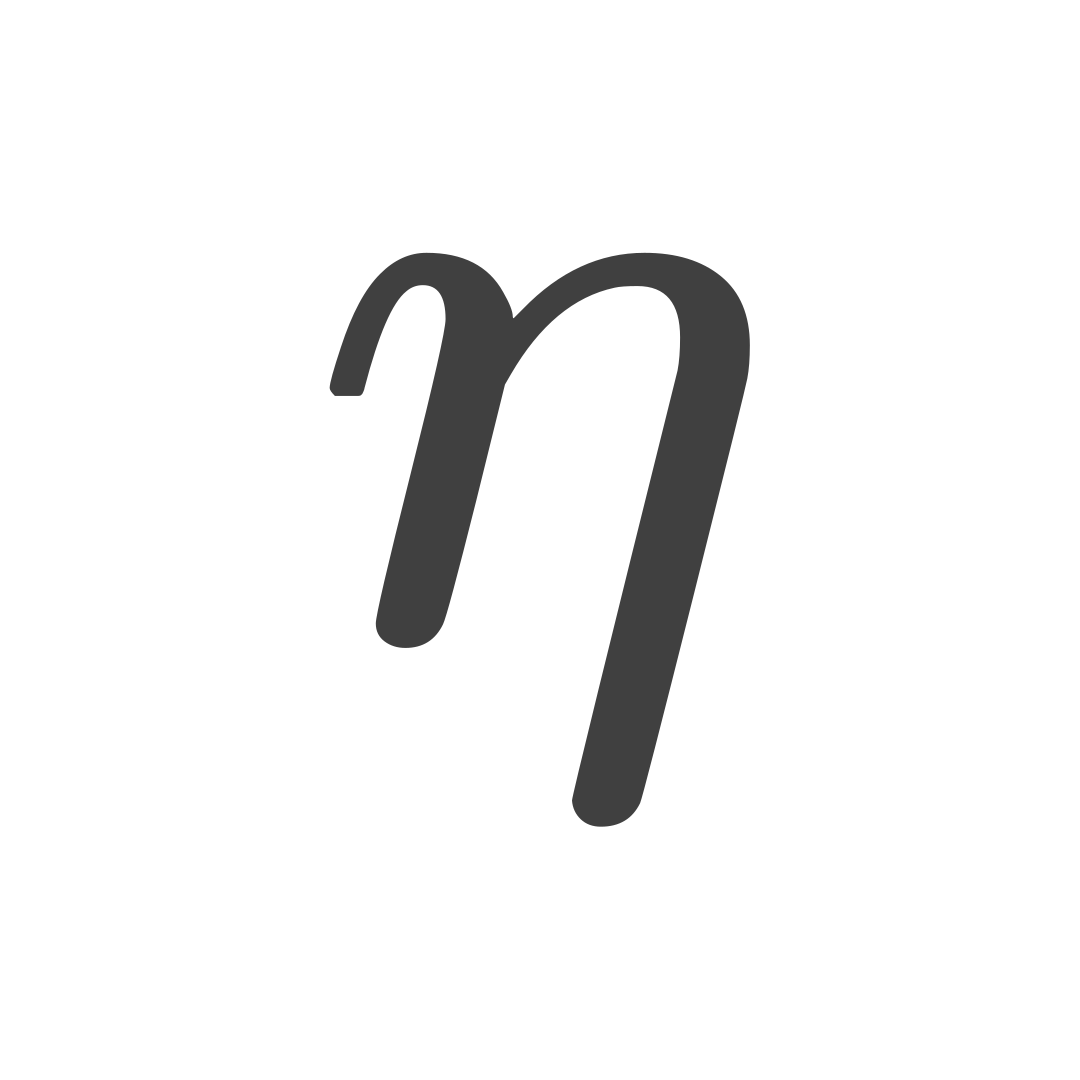
Dimension Describes the Type of Quantity
In everyday language, dimension often means spatial size such as length, width, and height. In physics, a dimension shows the base quantities and powers that form a physical quantity.
For example, bolt length, nut diameter, marble radius, and travel distance can use different units, but they are still the same kind of quantity.
Length, diameter, radius, and distance all have the length dimension .
A dimension does not state the measured value. It identifies the kind of physical quantity being measured.
Reading Powers in Dimensional Formulas
The visual below focuses only on the length dimension. Switch from length to area and then volume. Notice how one length factor becomes , , and .
- Formula
- SI unit
- Dimension
Base Quantities in Dimensional Analysis
The International System of Units or SI uses base quantities. The dimension of a derived quantity is written as a product of powers of the seven base dimensions.
| Base quantity | Example symbol | Dimension |
|---|---|---|
| Length | ||
| Mass | ||
| Time | ||
| Electric current | ||
| Thermodynamic temperature | ||
| Amount of substance | ||
| Luminous intensity |
Dimensions are written in square brackets so they are not confused with units. For example, is the dimension of length, while is the unit meter.
Deriving Dimensions from Formulas
Dimensional analysis works by replacing every quantity in a formula with its dimension, then simplifying the powers.
Force, work, and power can also be read as dimension structures.
Checking Dimensional Consistency in a Formula
Dimensions can help check whether a formula form could be correct. Every term being added must have the same dimension.
Take the displacement formula for uniformly accelerated motion:
Check the dimensions:
Both terms on the right have dimension , so the formula passes the dimensional check. Passing this check cannot prove that a formula is correct. The check can still catch impossible formulas quickly.
is invalid here because the dimensions differ: .
One Object Can Have Many Quantities
A bolt and a nut look like small objects, but measuring them can involve several different quantities. That is why one object sometimes needs more than one measuring tool.
| What is checked | Suitable tool | Dimension |
|---|---|---|
| Bolt length | ruler or vernier caliper | |
| Outer diameter | vernier caliper or micrometer screw gauge | |
| Cross-sectional area | calculated from diameter | |
| Material volume | calculated from spatial size | |
| Mass | balance | |
| Density | mass divided by volume |
So, two measuring tools can measure quantities with the same dimension, but they serve different contexts. A ruler is enough for a large length that does not need high precision. A vernier caliper or micrometer screw gauge is better when a small diameter must be read more carefully.
Dimensional analysis can test a proposed equation and help derive the unit of an unknown quantity.